




Resolving Chronic Track Bolt and Jamb Angle Loosening in Commercial Door Systems
Published: Nov 27, 2026
In this article (6 sections)
- The Root Cause: Transverse Vibration and the Junker Effect
- Diagnostic Checklist for Commercial Track and Jamb Assemblies
- Commercial Vibration-Proof Hardware Evaluation Matrix
- Step-by-Step Retrofit and Vibration Isolation Protocol
- Economic ROI: Maintenance Cost vs. Permanent Retrofit
- Frequently Asked Questions
Persistent track bolt and jamb angle loosening in high-cycle commercial overhead doors is typically driven by transverse vibration (the Junker effect), lateral track binding, worn roller bearings, or wallowed-out mounting holes that gradually walk standard fasteners backward. Simply retightening conventional hex nuts and lag screws fails because cyclic operational stress overcomes basic thread friction, eventually leading to track misalignment, cable despooling, and panel derailment.
To permanently secure commercial track assemblies and eliminate recurring service callbacks, facility maintenance teams must address both mechanical alignment and fastener retention:
-
Eliminate Lateral & Vibrational Stress: Realign pinched vertical tracks to restore proper roller play, and replace flat-spotted steel rollers or seized bearings that generate high-frequency chatter.
-
Repair Compromised Mounting Points: Replace wallowed-out jamb brackets and reinforce stripped wood, steel, or masonry anchors with heavy-duty structural fasteners.
-
Upgrade to Vibration-Proof Hardware: Swap standard nuts for wedge-lock washers, serrated flange nuts, or nylon-insert lock nuts paired with medium-strength threadlocker to resist transverse shear forces.
Transitioning from reactive retightening to engineering-backed hardware selection stops fastener back-out at the source, protecting both equipment uptime and facility personnel.
The Root Cause: Transverse Vibration and the Junker Effect
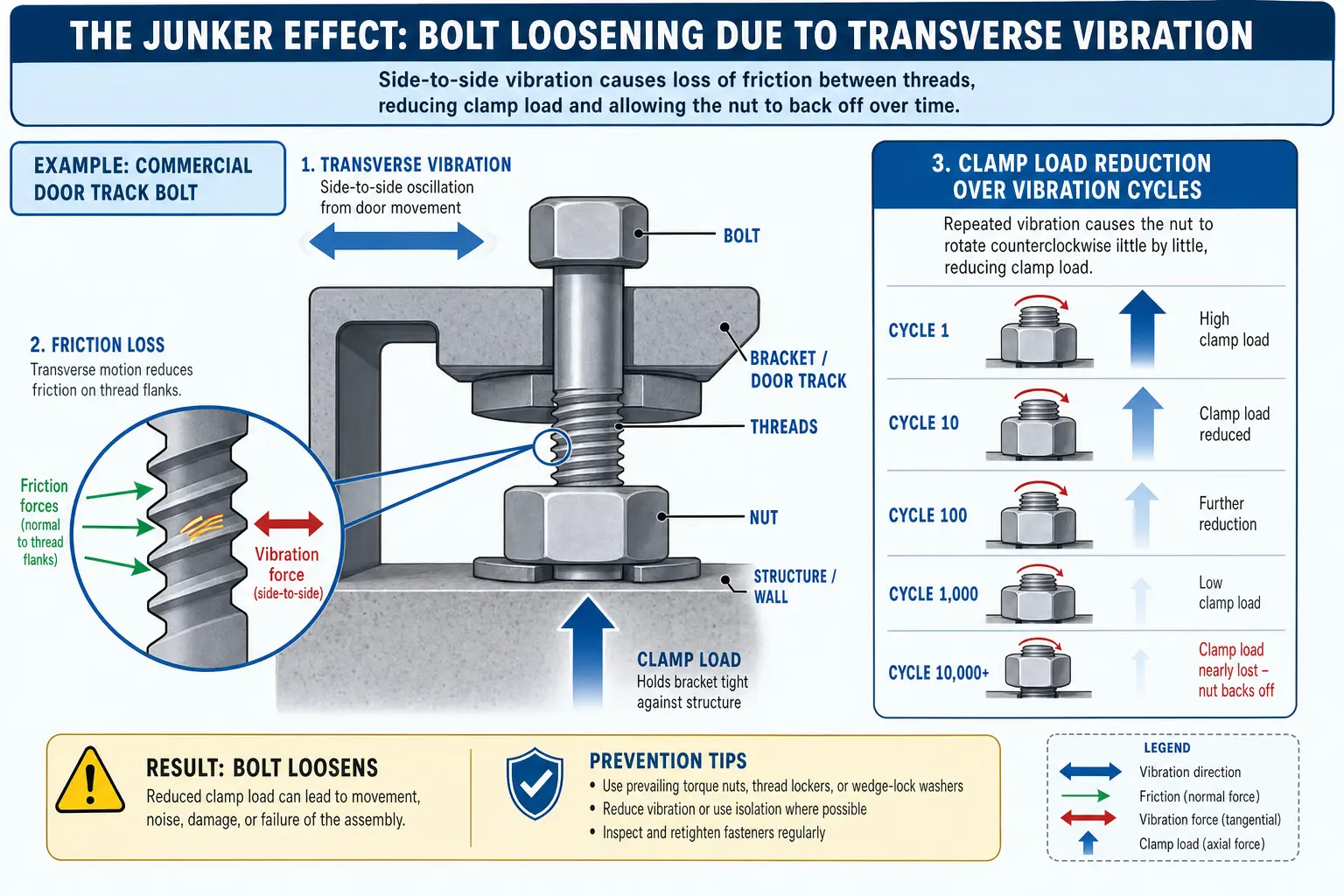
The underlying force causing fastener back-out in industrial environments is transverse vibration—a mechanical phenomenon evaluated under DIN 65151 and ISO 16130 standards known as the Junker Effect. When commercial roll-up or sectional doors travel along guide tracks, side-to-side dynamic shear forces oscillate perpendicular to the bolt axis. This movement causes relative motion between internal thread flanks, reducing friction across mating surfaces to near zero.
Under standard un-locked conditions, bolted joints lose 100% of their initial clamp load within 50 to 500 vibration cycles. While residential garage doors undergo approximately 1,000 cycles per year, high-traffic logistics hubs and distribution centers run high cycle automatic door systems experiencing 25,000 to over 100,000 cycles annually. This dynamic environment amplifies mechanical fastener fatigue by up to 40 times, rendering standard socket-wrench retightening ineffective over time.
Diagnostic Checklist for Commercial Track and Jamb Assemblies
Identifying hardware degradation before total joint failure requires systematic structural evaluation across specific mounting configurations:
- Bracket-Mounted Tracks: Check for elongated fastener slots, bolt head wear, and backed-out nuts along individual wall brackets.
- Continuous Angle Mounts: Inspect full-length steel angles for vertical shear movement or cracked field welds along masonry and structural steel jambs.
- Reverse Angle Jamb Steel: Look for joint separation between the mounting angle and structural wall anchors caused by heavy impact or motor vibration.
Ignoring bolt back-out accelerates hardware breakdown. According to U.S. Consumer Product Safety Commission (CPSC) data, over 2,200 emergency room injuries occur annually due to falling overhead doors and component collapses. Loose track angle anchors compromise structural stability, leading to track spreading and binding. Maintaining precise garage door track alignment prevents operational bottlenecks and avoids emergency garage door cable and roller repair.
Commercial Vibration-Proof Hardware Evaluation Matrix
Replacing failed OEM hardware requires selecting locking mechanisms specifically designed to resist transverse shear forces.
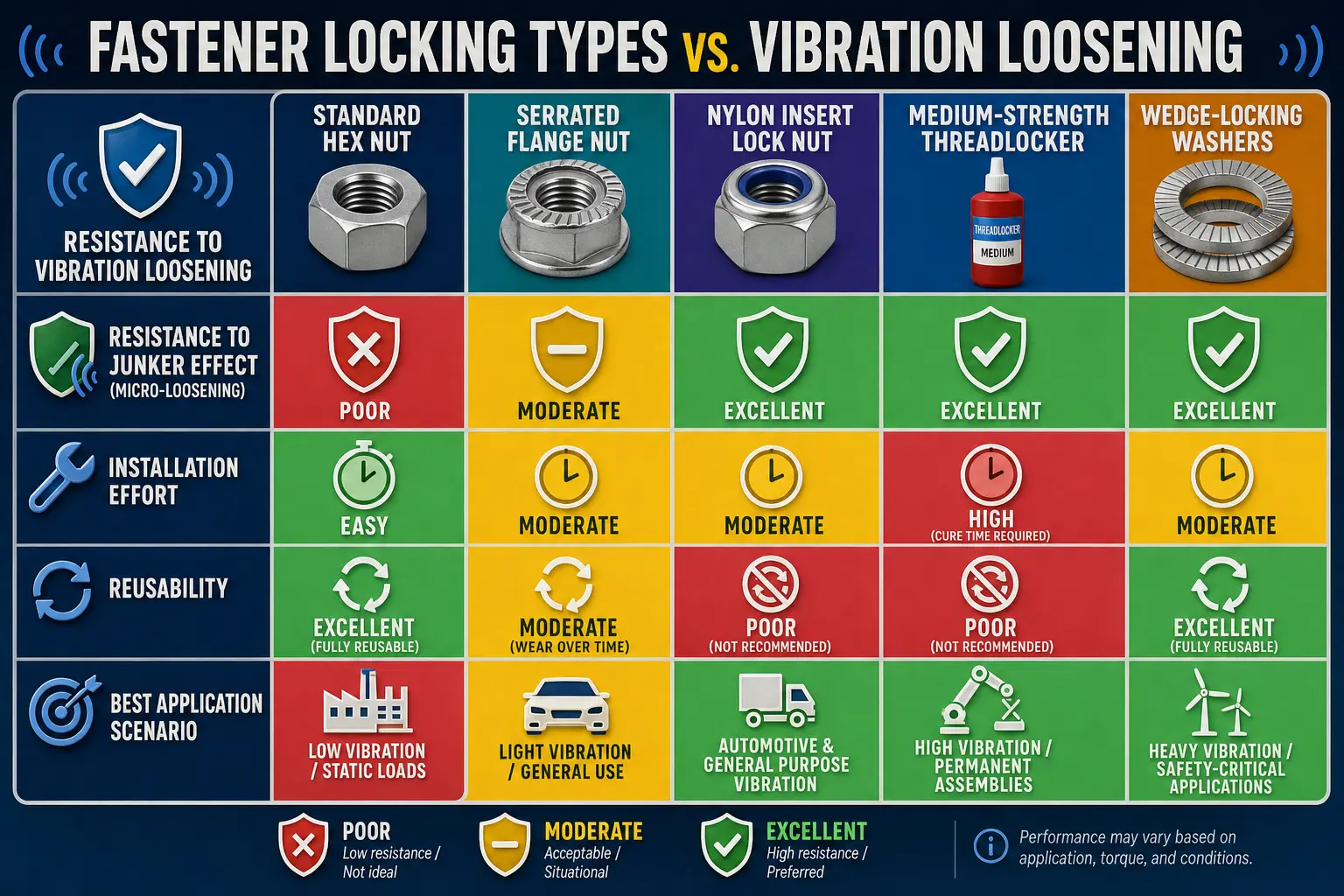
| Fastener / Lock Type | Resistance to Junker Vibration | Clamp Load Retention | Reusability / Maintenance Access | Best Commercial Application |
|---|---|---|---|---|
| Standard Hex Nut + Flat Washer | Very Poor (Fails <100 cycles) | 0% retention under vibration | High | Do NOT use on industrial tracks |
| Serrated Flange Lock Nut (Grade 5/8) | Moderate | 40–50% back-out reduction; 1.3x breakout torque | Moderate (Serrations wear mating face) | Standard track-to-angle bracket joints |
| Nylon Insert Lock Nut (Nyloc) | Good (Light/Medium Duty) | Prevents total nut loss; constant drag | Limited (Nylon degrades after 2-3 uses) | Hinge-to-section fasteners; ambient temp bays |
| Medium-Strength Threadlocker (Anaerobic 243) | Excellent | >85% clamp load retention | High (Hand-tool removable for service) | All threaded track-to-jamb fasteners |
| Wedge-Locking Washers (Nord-Lock Pairs) | Exceptional | >90% clamp retention via tension strain | High (Reusable multiple times) | Heavy industrial, high-cycle, & crane bays |
Step-by-Step Retrofit and Vibration Isolation Protocol
Upgrading commercial tracks to withstand continuous high-cycle operation requires structured installation protocols:
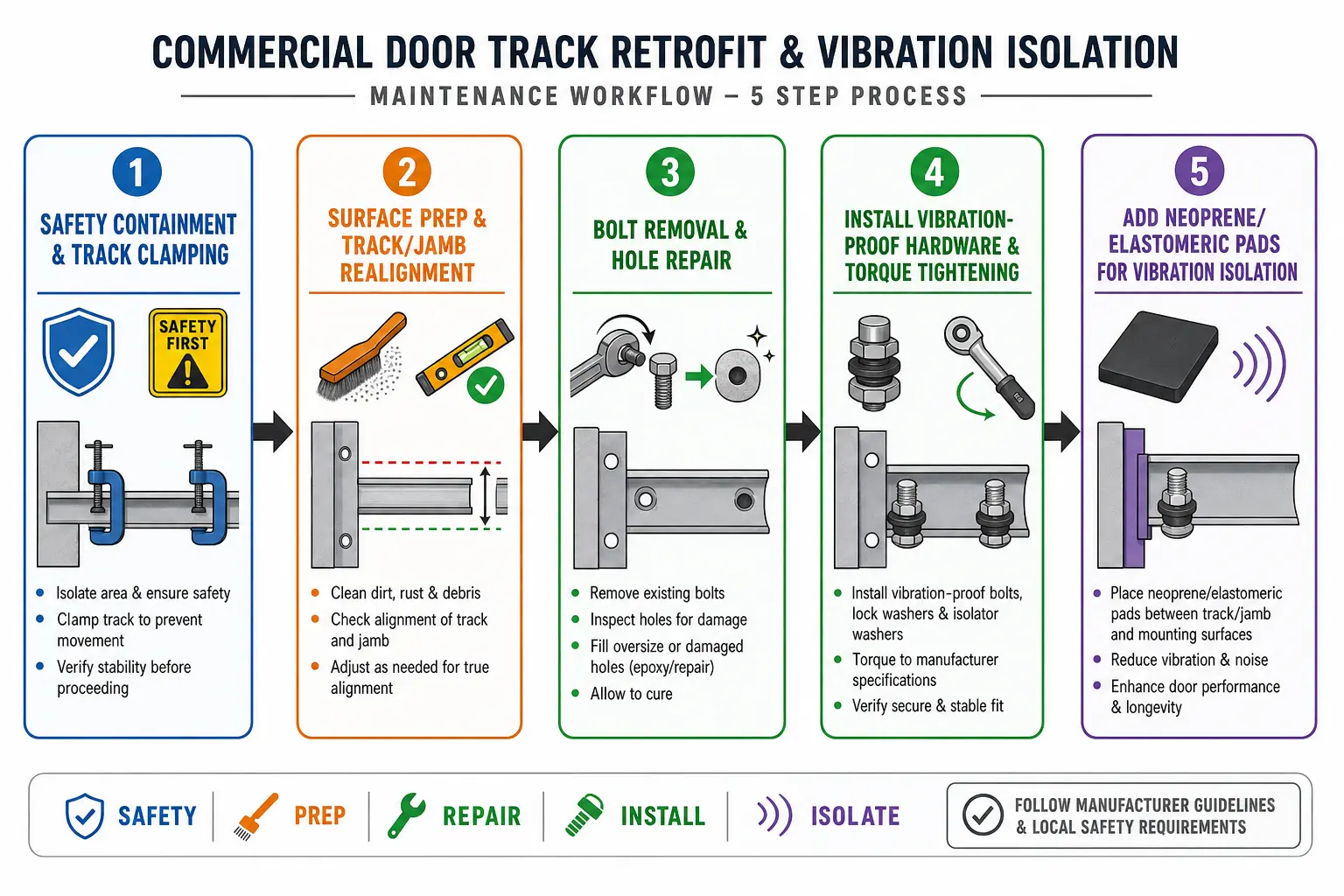
- Safety Containment: Lock out electrical power to the door operator. Secure the door panel in a fully closed position and clamp tracks to relieve mechanical tension.
- Surface Preparation & Inspection: Remove oil, rust, and debris from jamb angle mating surfaces using solvent degreasers. Verify track plumb within 1/16 inch during garage door track installation adjustments.
- Hardware Retrofitting: Replace standard bolts with Grade 5 or Grade 8 fasteners. Install serrated flange nuts paired with Medium-Strength Anaerobic 243 liquid threadlocker, or apply double-sided wedge-locking washers directly against the jamb angle face. Installing a proper garage door vibration isolator on operator mounts further isolates motor-induced harmonics from the track framework.
- Calibrated Torque Tightening: Torque 1/4″-20 track bolts to 75–90 in-lbs and 3/8″-16 jamb bolts to 25–30 ft-lbs using calibrated torque wrenches to establish proper initial thread preload.
Economic ROI: Maintenance Cost vs. Permanent Retrofit
Relying on temporary fixes creates compounding maintenance expenses. Emergency service calls for off-track commercial doors typically cost over $400 per response. Experiencing three recurring service visits annually costs facility operations $1,200 or more in direct repairs, plus significant indirect losses from loading dock downtime.
By contrast, retrofitting a commercial door assembly with engineered vibration-proof hardware costs less than $50 in materials and requires minimal internal labor. Establishing routine commercial facility door maintenance protects facility assets and maximizes ROI. Facilities managing high-traffic operational bays can consult experienced commercial garage door repair texas teams to audit structural track mounts and implement permanent vibration-proofing hardware solutions.
Frequently Asked Questions
Why do my track bolts back out even after tightening them with high torque?
Standard bolts rely solely on friction between mating threads to maintain clamp load. In high-cycle commercial environments, door movements create transverse (sideways) vibration—known as the Junker Effect—which reduces thread friction to near zero. High torque increases initial tension, but without positive mechanical locking hardware or chemical threadlockers, dynamic vibration will rapidly discharge that clamp load.
Should I use red or blue threadlocker on commercial track bolts?
Medium-strength blue threadlocker (such as Anaerobic 243) is ideal for commercial track bolts and jamb angles. It resists over 85% of vibration-induced self-loosening while remaining removable using standard hand tools during routine maintenance. High-strength red threadlocker requires high-heat localized application for disassembly, which complicates routine track realignment and part replacement.
How do Nord-Lock wedge-locking washers prevent track angle separation?
Nord-Lock washers use a pair of interlocking cams on the inside and radial teeth on the outside. When dynamic transverse vibration attempts to loosen the bolt, the internal cam angle is greater than the bolt thread pitch. This forces the washer pair to expand upward against the bolt head, creating a wedge effect that uses tension strain—rather than friction—to maintain over 90% of initial clamp load.
You May Also Like