




The Five Strategic Types of Garage Doors: A Homeowner’s Selection Guide
Published: Sep 16, 2026
Investing in a new garage door is one of the most financially rewarding home improvements you can make. According to the 2025 Cost vs. Value Report by Zonda and the Journal of Light Construction, a garage door replacement ranks as the absolute number-one remodeling project for return on investment. On average, homeowners spend $4,672 on this upgrade and recoup an impressive $12,507 in resale value—a massive 268% ROI.
However, maximizing this return requires making the right functional choice. Homeowners frequently struggle to separate the operating mechanism (how a door opens) from its aesthetic style (how it looks). Selecting the wrong mechanism can lead to costly structural modifications, clearance issues, or poor energy efficiency.
To make a confident decision, you must first evaluate the five physical operating mechanisms.
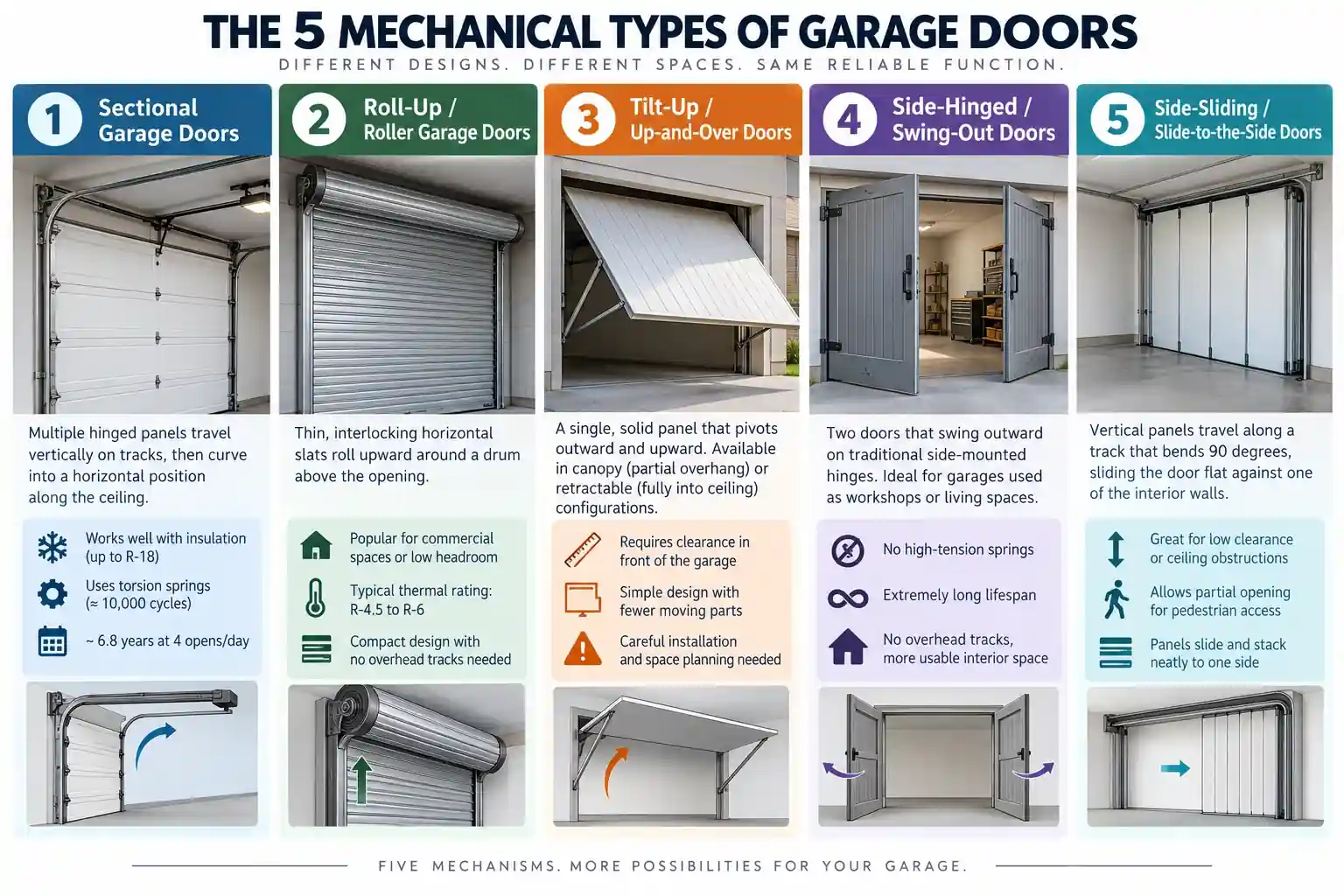
The 5 Mechanical Types of Garage Doors
1. Sectional Garage Doors
As the most popular residential choice in North America, sectional garage doors consist of several hinged horizontal panels. When operated, these panels travel vertically on tracks before curving into a horizontal position parallel to the garage ceiling.
This design allows for robust garage door insulation. Double-skinned, polyurethane-filled sectional models can achieve exceptional thermal ratings up to R-18. However, they rely on complex spring counterbalance systems. A typical torsion spring is rated for 10,000 cycles; if opened four times a day, those springs will snap in roughly 6.8 years, requiring professional replacement.
2. Roll-Up / Roller Garage Doors
Roll-up doors are composed of thin, interlocking horizontal slats that roll upward around a drum situated directly above the door opening. While highly popular in commercial spaces or homes with zero overhead track space, residential roll-up models rarely exceed thermal ratings of R-4.5 to R-6 due to the thinness of the slats and thermal bridging at the joints.
3. Tilt-Up / Up-and-Over Garage Doors
A tilt-up door is a single, solid panel that pivots outward and upward. There are two primary sub-types: canopy doors (which leave a portion of the door extending outward as an awning) and retractable doors (which slide fully back into the ceiling space).
Executing a proper tilt-up garage door installation requires careful clearance planning, as the single panel sweeps through an arc that extends several feet in front of the garage during operation.
4. Side-Hinged / Swing-Out Garage Doors
Evoking classic barn designs, side hinged garage doors swing outward on traditional side-mounted hinges. This mechanism is perfect for garages converted into workshops or active living areas because it eliminates overhead track assemblies entirely. Because they use no high-tension counterbalance springs, they boast an almost infinite mechanical lifespan and eliminate the safety risks associated with sudden spring failure.
5. Side-Sliding / Slide-to-the-Side Garage Doors
This innovative mechanism uses vertical panels that travel along a track that bends 90 degrees, sliding the door flat against one of the interior garage walls. They are ideal for garages with low clearance or structural ceiling obstructions, and they offer convenient partial-opening modes for quick pedestrian access.
Architectural Styles and Material Selection
Once you establish which physical mechanism fits your space, you can customize your door’s aesthetic. A classic “carriage” look is no longer restricted to swing-out doors; modern manufacturers construct beautiful, highly insulated carriage style garage doors that operate using a standard sectional overhead track.
If your property demands unique dimensions or specific architectural profiles, opting for custom garage doors allows you to pair your preferred mechanism with tailored window layouts, custom wood species, or flush aluminum panels. To find the right physical composition for your climate, read our overview of the pros and cons of garage door materials.
Structural Clearance Blueprint
Before finalizing your purchase, compare your physical garage dimensions against the following industry-standard clearance requirements:
| Mechanism Type | Min. Headroom Required | Min. Backroom Required | Min. Sideroom Required | Max. R-Value | Spring Lifespan (Avg.) |
|---|---|---|---|---|---|
| Sectional | 12″ – 18″ (4.5″ with low-headroom track) | Door Height + 18″ | 3.5″ to 4.5″ | R-18 | 10,000 cycles |
| Roll-Up | 12″ – 24″ | 0″ | 3″ to 5″ | R-6 | Internal drum spring |
| Tilt-Up | 2″ – 3″ | Door Height + 12″ | 2.5″ | R-10 | Pivot springs |
| Side-Hinged | 0″ | 0″ | 0″ | R-12 | Infinite (No springs) |
| Side-Sliding | 2″ | 0″ | Equal to door width | R-14 | Infinite (No springs) |
If you are dealing with a tight, flat ceiling or a low entryway, installing a specialized low headroom garage door track can reduce the required overhead clearance to as little as 4.5 inches.
To ensure safe, precise operation, we highly recommend working with local professionals. If you need help determining compatibility, schedule a professional site assessment to secure a flawless garage door installation near me.
Frequently Asked Questions
How does a garage door spring work to balance the door?
To lift doors that weigh hundreds of pounds, standard sectional and tilt-up mechanisms rely on high-tension counterbalance systems. If you want to understand how these systems generate lift, explore our detailed guide on how does a garage door spring work.
Why are garage door springs dangerous to replace as a DIY project?
Because these spring systems operate under extreme mechanical tension, a sudden failure or improper adjustment can release immense force, causing catastrophic property damage or severe bodily injury. Read our safety overview on why are garage door springs dangerous to learn about the critical risks of amateur handling.
Which garage door type is best for cold climates?
Sectional garage doors offer the highest thermal boundary efficiency. Their double-walled, polyurethane-insulated steel panels fit tightly within weather-sealed tracks, blocking wind infiltration far more effectively than thin-slat roll-up doors or pivoting tilt-up doors.
You May Also Like