





Inside Side-Hinged Garage Doors: Essential Components And Structural Anatomy
Published: Aug 12, 2026
Choosing a new garage door is a significant long-term investment. While sectional and roller doors have dominated recent decades, many homeowners are returning to the classic functionality of side hinged garage doors. This return is driven by practical advantages: instant pedestrian access, zero headroom loss, and a simpler mechanical footprint.
However, selecting the right door requires looking past basic aesthetics. You need to understand the mechanical components, thermal science, and structural tolerances that separate a door that sags and warps from one that operates flawlessly for decades.
Hinge Mechanics & Load Dynamics
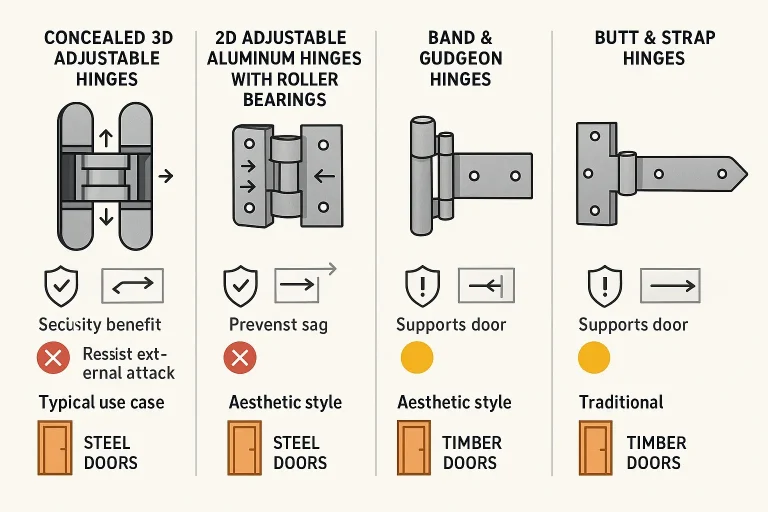
The entire weight of a side-hinged door leaf relies on its hinges. Understanding the engineering behind different types of garage door hinges is critical to preventing structural sag over time.
- Strap Hinges: Popular for traditional carriage houses, these long metal bands distribute weight across the panel face. However, they lack adjustment options and are vulnerable to weathering.
- Butt Hinges: A simple, cost-effective choice. However, if the hinge pins are exposed on the exterior, they present a significant security vulnerability.
- 3D-Adjustable Concealed Hinges: The gold standard in modern door engineering. These hinges remain hidden inside the frame when the door is closed, preventing lever attacks. From a practical standpoint, concealed hinges recover up to 80mm (roughly 3.1 inches) of lateral drive-through clearance compared to surface-mounted butt hinges. Additionally, they allow installers to fine-tune the door across three distinct axes (X: lateral alignment, Y: height, Z: gasket compression) to counteract future building settling.
To support heavy insulated steel leaves, premium systems integrate passive hinge bolts (dog bolts). These solid steel pins lock directly from the leaf into the frame rebate upon closing, preventing the door from being lifted off its hinges during a break-in attempt.
Frame Profiles & Structural Integrity
A door leaf is only as reliable as the frame holding it. Proper framing garage door planning prevents moisture issues and structural shifting.
While timber frames offer a classic look, they are highly prone to moisture absorption, swelling, and twisting. For long-term reliability, hollow galvanized steel or extruded aluminum frames are the industry standards. To maximize energy efficiency, high-end aluminum frames utilize a polyamide thermal break. This internal structural barrier isolates the exterior metal from the interior metal, preventing “cold bridging” and interior condensation.
These frames are built with deep profiles (typically 60mm to 80mm) and integrated rebates that house continuous compression seals. This ensures the door closes tightly against driving rain and high winds.
Panel Anatomy & Thermal Science
When researching a modern insulated garage door, look closely at the panel construction. Premium doors utilize a double-skin design, sandwiching a rigid, CFC-free polyurethane (PU) foam core between two hot-galvanized steel sheets. This structure delivers excellent steel garage door benefits, including impact resistance and superior thermal performance.
To evaluate thermal claims accurately, you must distinguish between two different metrics:
- Panel-Only U-Value: Many manufacturers quote a panel-only U-value, which represents the center-of-panel insulation.
- Complete-System Garage door u factor: This real-world measurement factors in the frame, panel joints, and weather seals.
Locking Mechanisms & Security Standards
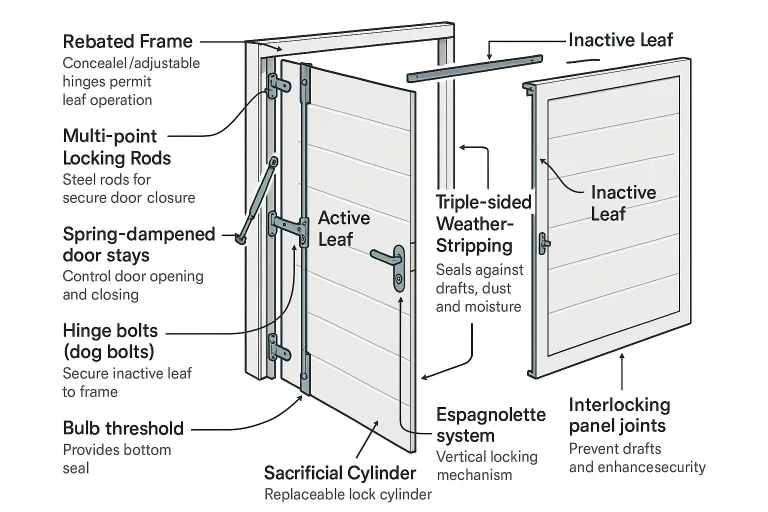
Side-hinged doors require secure locking systems across both the active and inactive leaves to establish a robust physical barrier.
Active Leaf
The active leaf (the primary door you open) should utilize a multi-point locking system. This mechanism secures the door at multiple points along the frame rebate using a standard latch bolt combined with two heavy-duty hook bolts. For proper protection, look for locks paired with BS EN 1303 Grade 2 cylinder locks. These cylinders feature sacrificial snap lines, anti-drill pins, and anti-pick designs to resist common forced entry techniques.
Inactive Leaf
The inactive leaf must be anchored securely inside the frame header and threshold using internal flush shoot bolts. Using adjustable flush-bolt keepers allows you to maintain a tight weather seal as the rubber gaskets age.
Investing in high-grade locking systems ensures you install the most secure garage door possible.
Environmental Protection: Seals & Thresholds
An effective weather barrier relies on high-quality gaskets and a smart threshold design.
For reliable, long-term performance, look for epdm garage door seal profiles. EPDM remains flexible in freezing temperatures and resists UV degradation. A continuous bulb gasket should run along the perimeter of both leaves, sealing against the rebate.
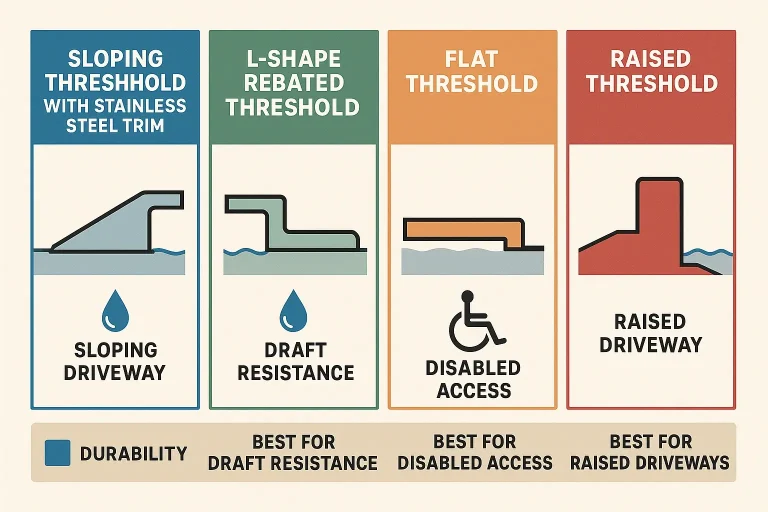
At ground level, a raised, ramped three-part aluminum threshold with a built-in thermal break is essential. This design directs rainwater away from the garage and provides a solid surface for the bottom EPDM gaskets to compress against, keeping wind and moisture outside. Understanding the importance of garage door weather stripping is key to maintaining a dry, draft-free garage space.
Operational Safeguards: Stay Arms & Openers
Side-hinged doors operate best with integrated hardware that controls their swing path.
- Door Stays: Standard spring-dampened friction stays hold doors open at 90° or 105°. However, in areas with wind speeds exceeding 25 mph (Class 2 wind loads), heavy-duty hydraulic gas struts are recommended to prevent the doors from catching the wind and slamming shut.
- Automation: If you want an automatic setup, you can pair a traditional ceiling-mounted garage door opener with a swing-arm converter. This system uses curved arms to pull the doors inward and push them outward smoothly and securely.
Frequently Asked Questions
Can side-hinged doors be automated?
Yes. By using a standard ceiling-mounted boom operator combined with a specialized swing-arm conversion kit, you can easily automate side-hinged doors.
Do side-hinged doors sag over time?
Timber doors are susceptible to warping and sagging due to seasonal moisture changes. However, modern double-skin steel systems installed with 3D-adjustable hinges avoid this issue entirely by allowing precise alignment corrections.
What is the advantage of an asymmetrical (1/3 to 2/3) split?
An asymmetrical split creates a smaller active leaf that acts as a standard pedestrian door. This lets you enter and exit quickly without opening the larger leaf, keeping your garage’s contents private and preserving the indoor temperature.
You May Also Like
Maximizing Garage Door Hinge Lifespan
Is your garage door trying to tell you something? Those squeaks, groans, and stutters aren't just annoying noises—they're often cries for help from one of the hardest-working parts of the system: the hinges. Think of…
Published Date: Jan 28, 2026
Garage Door Hinge Types: Everything You Need to Know
Understanding the garage door hinge types on your door may seem minor — until one wears out, causes noise, or throws your door out of alignment. Whether you're replacing a part or upgrading hardware, knowing the…
Published Date: Dec 5, 2025
How to Fix My Garage Door Safely Without Making Things Worse
Rain’s coming down, you hit the remote, and nothing happens. Now you’re stuck in the driveway, wondering, “How to fix my garage door?” Or maybe your garage door has gotten noisy? The solution is often simpler than it…
Published Date: Nov 21, 2025