





Modern Side-Hinged Garage Doors: Engineering And Fit
Published: Aug 13, 2026
For many homeowners, the garage is no longer just a cold storage space for vehicles. It has evolved into an active, high-value extension of the home—serving as a home office, personal gym, workshop, or utility suite. This functional shift requires a complete rethink of the garage entry system.
Traditional overhead doors can be cumbersome, offering poor insulation and limited pedestrian access. Modern side hinged garage doors solve these issues, delivering smooth, walk-through access, enhanced thermal efficiency, and classic architectural appeal.
Evaluating side-hinged systems requires looking closely at materials, clearances, thermal ratings, and hardware. This guide breaks down the essential technical and aesthetic considerations to help you select the ideal engineered doorset for your home.
Architectural Styles & Spatial Configurations
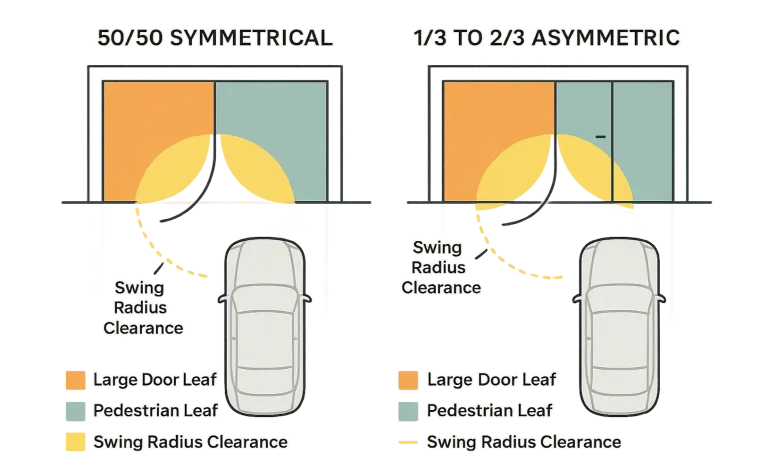
Unlike overhead doors that retract along ceiling tracks, side-hinged doors swing outward on heavy-duty hinges. This design frees up valuable ceiling space for lighting, overhead storage, or utility piping, but it requires careful spatial planning.
Selecting Your Configuration: 50/50 Symmetrical vs. Asymmetric Splits
- 50/50 Symmetrical Split: Two equal-sized doors that open from the center. This layout is ideal for garages where vehicles are still regularly parked, providing a wide, balanced opening.
- 1/3 to 2/3 Asymmetric Split: Features a smaller active pedestrian leaf (the 1/3 door) and a larger secondary leaf (the 2/3 door). This setup functions as a standard entry door for quick access to grab a bicycle or tools, keeping the larger door closed to preserve climate control and reduce wear on hinges.
Choosing Your Style
Your garage door should complement your home’s architecture. Whether you are looking for carriage style garage doors without windows to preserve historic charm or sleek panels with vertical glazing to enhance curb appeal with modern garage doors, side-hinged designs offer exceptional versatility:
- Carriage House & Rustic: Replicates historic 19th-century swing-out carriage doors with vertical paneling, mock center stiles, and decorative iron straps.
- Modern Minimalist: Features smooth steel panels, horizontal layouts (micro-rib or macro-rib patterns), and integrated double-glazed window bands with frosted or tinted glass.
Calculating the Swing Radius
Before selecting a side-hinged design, measure your driveway’s slope and clearance arc. Outward-swinging doors require a completely clear path. Sloping driveways, boundary walls, or parked vehicles can block the door’s path. If your driveway slopes upward toward the street, a standard side-hinged door may scrape the ground, requiring rising hinges or a custom threshold adjustment.
Engineered Doorsets vs. Loose Slabs
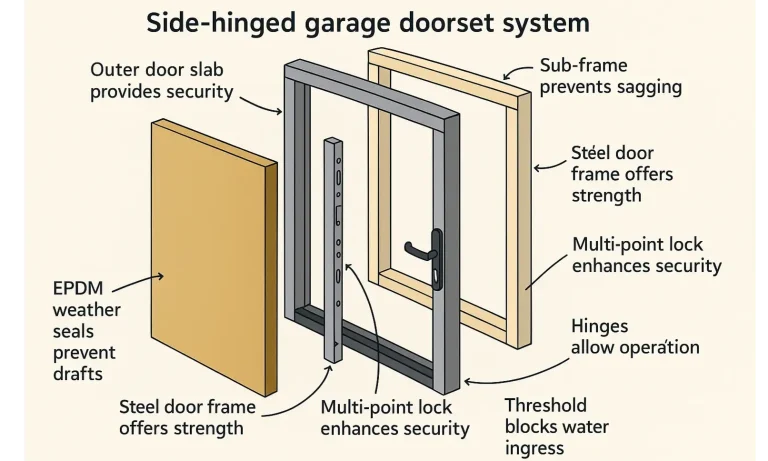
A common mistake is purchasing loose door slabs and hanging them on an existing timber frame. This approach often leads to drafts, sagging, and alignment issues.
For long-term reliability, choose a complete engineered doorset. This system includes the door panels pre-hung in a matching steel or aluminum sub-frame, complete with built-in EPDM weatherstripping, adjustable hinges, and an integrated threshold.
This factory-assembled configuration ensures the doors remain perfectly square, provides a tight weather seal, and greatly reduces installation time.
The Great Material Showdown
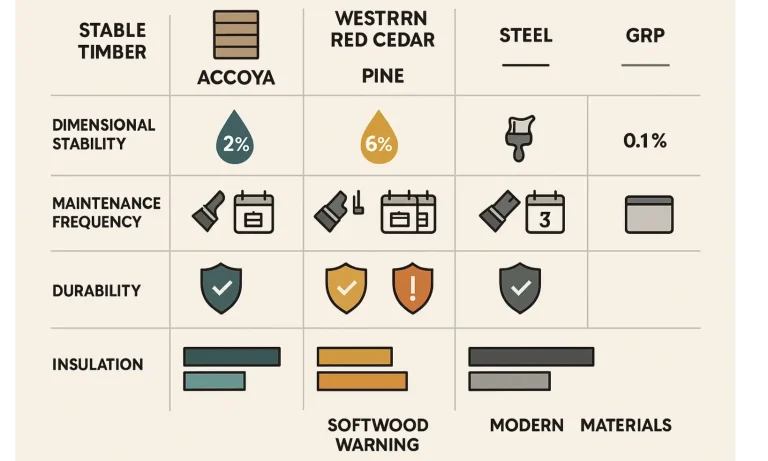
Choosing the right material impacts the door’s durability, insulation capacity, and maintenance needs. Understanding the pros and cons of garage door materials will help you make a lasting investment.
Premium Timber: Elite Stability vs. Softwood Warnings
Many homeowners seek the natural warmth of real wood, but choosing the wrong species can lead to issues. Cheap, untreated softwoods (like standard pine or redwood) can warp, swell, and bind in damp winter weather, with dimensional movement reaching 3% to 5%. This movement can cause the doors to stick and misalign with the locking latch.
To prevent these issues, look for premium timber species:
- Accoya Wood: Chemically modified wood that exhibits less than 0.8% dimensional change. It is rot-resistant, highly stable, and can go up to 10 years without requiring a paint recoat.
- Western Red Cedar: Lightweight, naturally resinous, and exceptionally stable in wet climates.
- Idigbo: A dense hardwood that mimics the look of oak but is lighter, stable, and naturally rot-resistant.
When investing in wood, ensure you use the best wood for garage door frame construction to prevent structural sagging over time.
Insulated Steel Systems
If low maintenance and maximum thermal efficiency are your top priorities, double-skinned insulated steel is an excellent choice.
These doors feature a 40mm (1-5/8″) high-density polyurethane foam core sandwiched between galvanized steel sheets. While the raw panel achieves an R-value of 4.73 (panel thermal transmittance of 0.56 W/m²K), the fully installed doorset system—including aluminum sub-frames and dual EPDM rubber seals—typically delivers a real-world system U-value of 2.20 W/m²K. This high-performance garage door insulation prevents cold drafts and keeps your workspace comfortable year-round.
Composite and GRP (Glass Reinforced Polyester)
GRP is an excellent alternative for coastal regions exposed to salt air. It is entirely rot-proof, rust-proof, and can be molded to replicate realistic wood grain patterns. Investing in modern faux wood garage doors provides the traditional look of timber without the ongoing refinishing requirements.
Security and Functional Hardware
Because side-hinged doors swing open at eye level, they require robust locking systems to prevent forced entry. Standard single-point locks can be vulnerable to basic tools.
Upgrading to a rebated meeting stile with a 3-point or 5-point euro-cylinder locking system provides superior security. This design uses steel hooks or shoot-bolts that latch deep into the frame at multiple points, resisting common garage door security risks and aligning with strict security standards like PAS24 or LPS 1175.
Additionally, high-quality doorsets feature functional hardware like:
- Friction Door Stays: Device limits that hold the doors open at 90 degrees, preventing wind gusts from slamming them shut.
- Adjustable 3D Hinges: Allows for precise vertical, horizontal, and depth adjustments to correct minor structural settling over the years.
Frequently Asked Questions
Will heavy timber side-hinged doors sag over time?
Timber doors can sag if they are hung on lightweight timber frames with standard butt hinges. Choosing an engineered doorset with a steel or aluminum sub-frame and adjustable 3D hinges prevents sagging, allowing you to easily adjust the door’s alignment over time.
Can side-hinged garage doors be automated?
Yes. Side-hinged doors can be automated using specialized swing-gate style arm operators or traditional overhead openers fitted with swing-door conversion bows.
How do they perform in heavy rain or snow?
Engineered doorsets feature built-in drainage channels, rebated frames, and dual EPDM rubber gaskets that seal tightly against a low-profile threshold. This system keeps driving rain, wind, and snow out of your garage workspace.
Take the Next Step
Selecting the right door requires balancing visual appeal with precise engineering. Whether you want to customize your garage’s look or need a complete, professional installation, our team is here to help. Contact Up & Down Garage Doors to schedule a professional consultation and find a local expert for garage door installation near me today. Let’s design a secure, energy-efficient, and beautiful entrance for your home.
You May Also Like
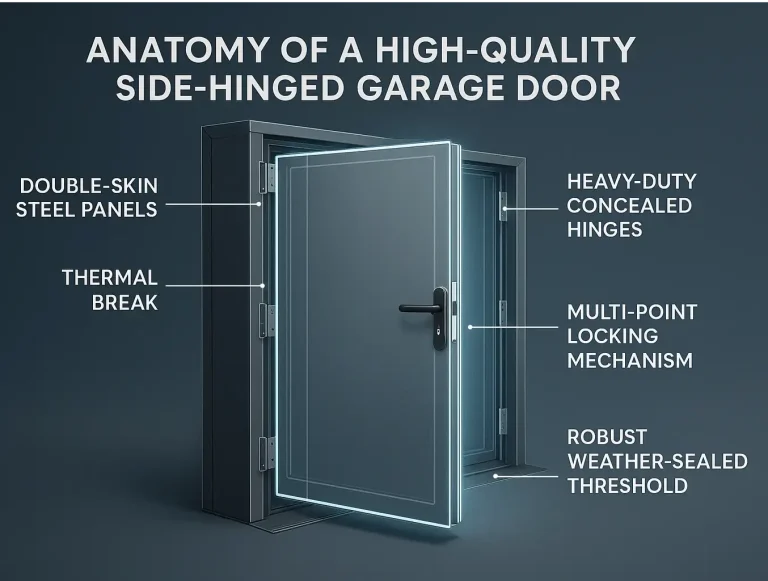
Inside Side-Hinged Garage Doors: Essential Components And Structural Anatomy
Choosing a new garage door is a significant long-term investment. While sectional and roller doors have dominated recent decades, many homeowners are returning to the classic functionality of side hinged garage doors…
Published Date: Aug 12, 2026
Garage Door Hinge Types: Everything You Need to Know
Understanding the garage door hinge types on your door may seem minor — until one wears out, causes noise, or throws your door out of alignment. Whether you're replacing a part or upgrading hardware, knowing the…
Published Date: Dec 5, 2025
Why Your Garage Door Is So Loud: 5 Common Causes and Fixes
Do you hear your garage door groan, grind, or screech every time it moves? A noisy garage door is your system’s warning light — usually caused by friction, misalignment, or worn parts. In this guide, Up & Down Garage…
Published Date: Nov 3, 2025