





Code Grabbing: The Simple Hack That Changed Garage Door Security Forever
Published: Jul 24, 2026
Your garage door remote does something remarkable. Every time you press that button, it sends a unique, one-time code to the receiver. This code will likely never be repeated in your lifetime. With billions of possible combinations, it’s one of the most secure devices you use daily.
The story begins with a simple flaw in older systems—a vulnerability so straightforward that it forced the entire industry to evolve. It’s the story of code grabbing, and understanding it is the key to appreciating the security protecting your home today.
The Old Way: When Your Garage Door Had a Single, Static Password
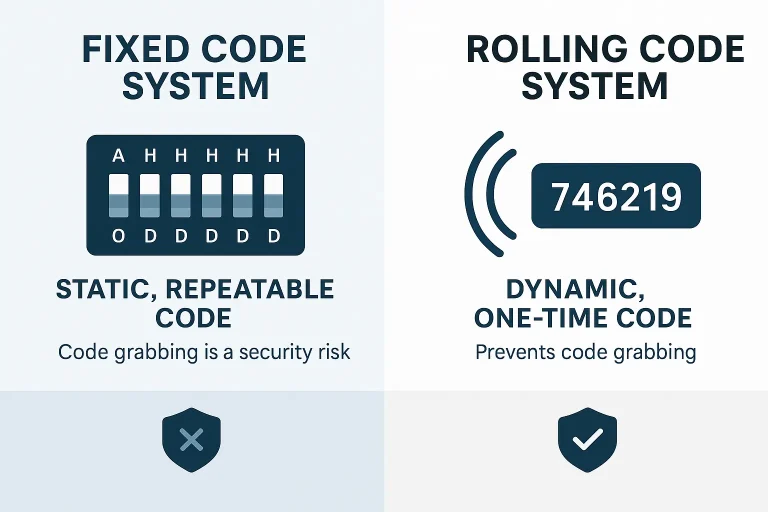
Before the mid-1990s, most garage door openers operated on a “fixed code” system. Inside the remote and the opener motor, you’d find a series of small, physical toggles called DIP switches. The pattern of these switches—up or down—created a single, unchanging code.
Think of it like a simple password that never changes. When you pressed your remote, it broadcasted that one specific code, and if it matched the code set on the receiver, your door would open. It was simple and effective, but it had a glaring weakness. To learn more about this technology, you can explore in-depth what is a dip switch garage door opener.
The Birth of “Code Grabbing”
Because the code was always the same, it was vulnerable. Thieves developed devices called “code grabbers,” which were essentially radio scanners that could record the signal your remote sent.
The process was alarmingly simple:
- A thief would wait near your home, perhaps down the street.
- When you used your remote to open or close your garage, their device would “grab” and record the radio frequency signal containing your fixed code.
- Later, they could simply re-broadcast that same code, and your garage door opener, not knowing the difference, would open for them.
It was the digital equivalent of someone peeking over your shoulder as you type your password. The system couldn’t tell the difference between the original signal and a copied one. This critical vulnerability is what made the shift to a new technology essential.
How Rolling Codes Solved the Problem
To combat code grabbing, engineers developed a brilliant solution: rolling code technology, sometimes called a “hopping code.”
Instead of a single, static password, a rolling code system uses a password that changes every single time you use it. Here’s how it works:
- Synchronization: Your remote and your opener’s receiver share a secret, synchronized algorithm. When they are first paired, they agree on a starting point and a mathematical rule for generating the next code.
- One-Time Use: When you press the button, the remote sends the next code in the sequence. The receiver recognizes it, uses it once to open the door, and then “listens” for the next code in the sequence.
- Invalidating Old Codes: Because the code has already been used, it’s now invalid. If a thief were to grab that signal and try to replay it, the receiver would ignore it because it’s no longer the code it’s expecting.
This simple but powerful concept made code grabbing obsolete overnight. The password was no longer a fixed secret but a moving target.
Testing the Armor: Are Rolling Codes Unhackable?
For decades, rolling code technology has been the gold standard for garage door security. It completely defeats simple code-grabbing attacks. However, as technology advances, so do the methods of those trying to break it.
While extremely rare in the real world, security researchers have demonstrated a more sophisticated attack that can, in theory, bypass some rolling code systems.
Understanding the RollJam Attack
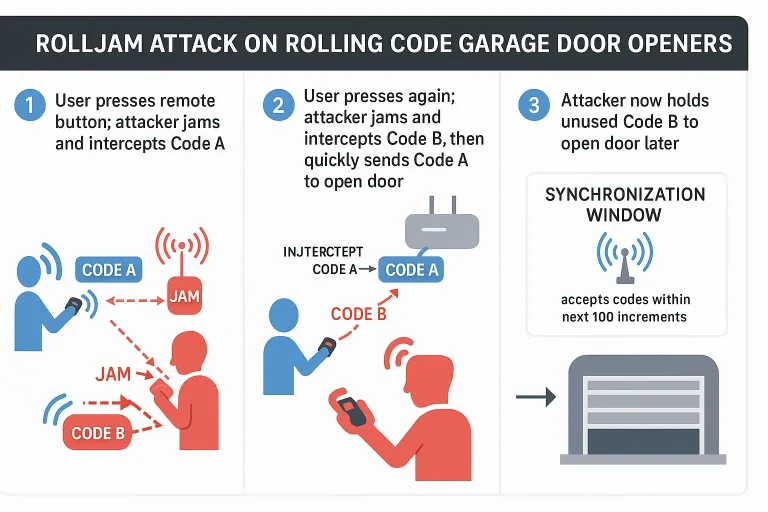
The most well-known vulnerability is called “RollJam.” It’s a clever technique that combines radio jamming with code grabbing.
Here’s a simplified breakdown:
- Jam & Grab: The attacker places a device near your garage. When you press your remote, the device jams the signal so your opener doesn’t receive it, but it simultaneously records your code (let’s call it Code A). From your perspective, it just looks like the remote didn’t work the first time.
- Press Again: Naturally, you press the button again. The RollJam device repeats the process: it jams the signal and records the new code (Code B).
- The Replay: Now, the device sends the first code it stole (Code A) to your opener. Your opener accepts it, and the door opens. The attacker now has your second, unused code (Code B) stored, which they can use later to open your garage at will.
While this sounds scary, it’s important to note that this attack requires specialized hardware, close proximity, and technical skill, making it highly unlikely for the average homeowner to encounter. Modern openers from leading brands have also implemented countermeasures to mitigate this risk.
How to Be Secure Today: From Awareness to Action
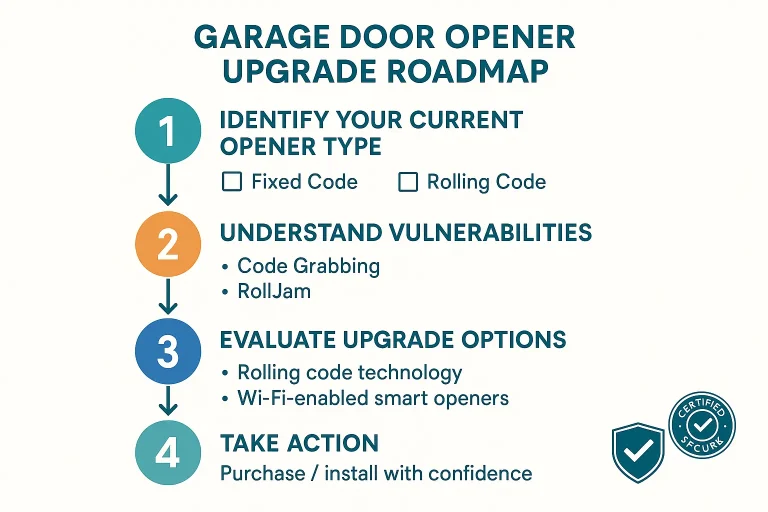
Understanding the evolution of opener security empowers you to make informed decisions about your home. The most important step is knowing what kind of system you have.
Identify Your System
So, how do I know if my garage door opener has a rolling code? Here are a few clues:
- Age: If your opener was manufactured before 1995, it most likely uses a fixed-code system.
- The “Learn” Button: Most rolling code openers have a “Learn” or “Smart” button on the motor unit, which is used for programming new remotes. Fixed-code systems typically rely on physical DIP switches.
- Manufacturer Information: Brands like LiftMaster and Chamberlain introduced their rolling code technology (Security+) in the mid-1990s. Checking your model number online can often tell you its security features.
If you suspect you have an outdated fixed-code opener, upgrading is one of the most effective security improvements you can make for your home.
Frequently Asked Questions (FAQ)
What is code grabbing in simple terms?
Code grabbing is the act of using a radio scanner to record the signal from a garage door remote and then replaying that signal later to open the door. It only works on older, fixed-code systems where the code never changes.
Is my old garage door opener with DIP switches safe?
Unfortunately, any opener that uses a fixed code (like those with DIP switches) is vulnerable to code grabbing. While the risk may be low, the technology is outdated and considered insecure by modern standards. Knowing how to secure your garage door is a critical part of homeownership.
How worried should I be about a RollJam attack?
For the average homeowner, the risk of a RollJam attack is extremely low. It requires specific technical expertise and equipment that is not common. Modern openers have further enhanced their security protocols, making such attacks even more difficult.
Does having a Wi-Fi-enabled “smart” opener affect its security?
A smart opener adds a new layer of convenience and potential vulnerability. While the remote still uses secure rolling code technology, the Wi-Fi connection needs to be secured. This means using a strong, unique password for your home Wi-Fi network and for the opener’s app. This is similar to ensuring your garage door keypad security is robust.
Your Next Step in Home Security
The journey from a simple, predictable code to a dynamic, ever-changing one is a perfect example of how security evolves. What was once state-of-the-art can become a liability over time.By understanding the “why” behind rolling code technology, you’re better equipped to assess your own garage door security risks and ensure your home’s largest moving object is protected by the best technology available.
You May Also Like
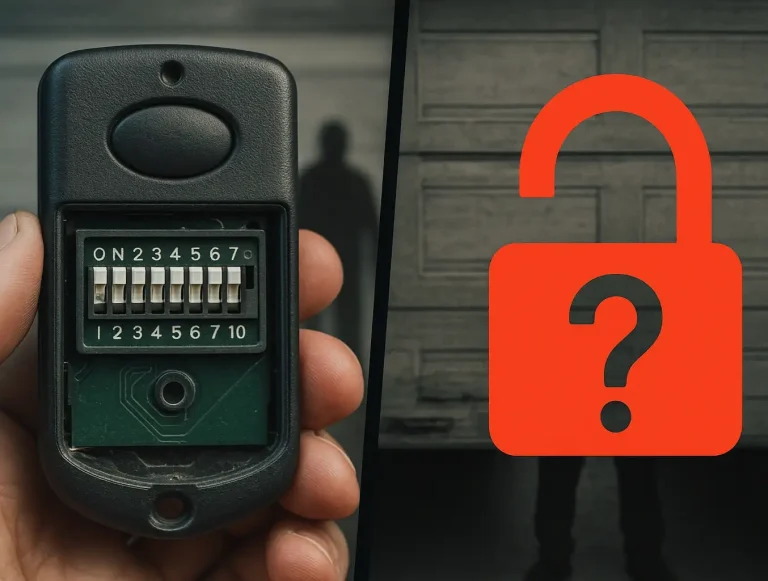
Legacy Fixed Code Garage Openers and Modern Security Risks
You pull into your driveway, press a button, and like magic, your garage door glides open. It’s a moment of convenience we take for granted. But what if that simple remote in your car is broadcasting an open…
Published Date: Jul 22, 2026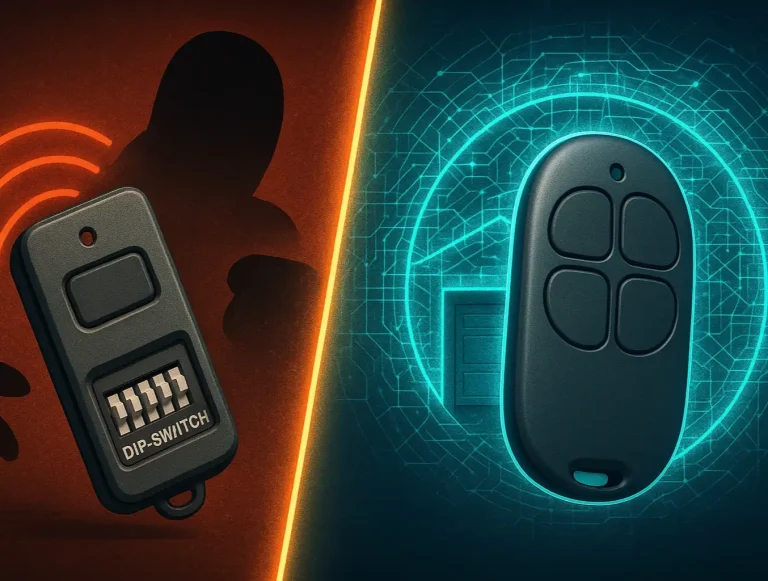
Guide To Prevent Garage Signal Theft: Code Grabber Security Tips
Welcome to the world of "code grabbing," a sophisticated electronic threat that allows intruders to duplicate your garage door opener’s signal and walk right in. While the 6-second break-in gets all the attention,…
Published Date: Jul 7, 2026
Changing the Code on Older Genie Intellicode Keypads
You’re standing outside, juggling groceries, and the familiar convenience of your garage door keypad suddenly feels like a betrayal. You punch in the code, and… nothing. You try again. Still nothing. After a quick…
Published Date: May 7, 2026