




Is Your Garage Safe? The Security Vulnerabilities of Dip Switch Garage Door Openers
Published: Sep 15, 2026
If you slide off the back cover of your garage door remote and see a row of 8, 10, or 12 tiny physical switches, your home is vulnerable. Many homeowners treat these systems as durable legacy hardware, simply trying to program a replacement remote when they fail. However, understanding what is a dip switch garage door opener means recognizing a massive security risk. Those physical switches rely on outdated “fixed-code” technology that can be compromised in less than 10 seconds.
Anatomy of a Dip Switch Opener: How Old Systems Work
Dip switch systems, operating primarily on legacy garage door remote frequency ranges of 300 to 390 MHz, use physical pins to set a static key. When you press the button, the remote broadcasts this exact key to the receiver. If the patterns match, the door opens.
Binary vs. Trinary Switches: Why the Math Matters
The cryptographic strength of these systems is exceptionally weak because of how few combinations they can generate:
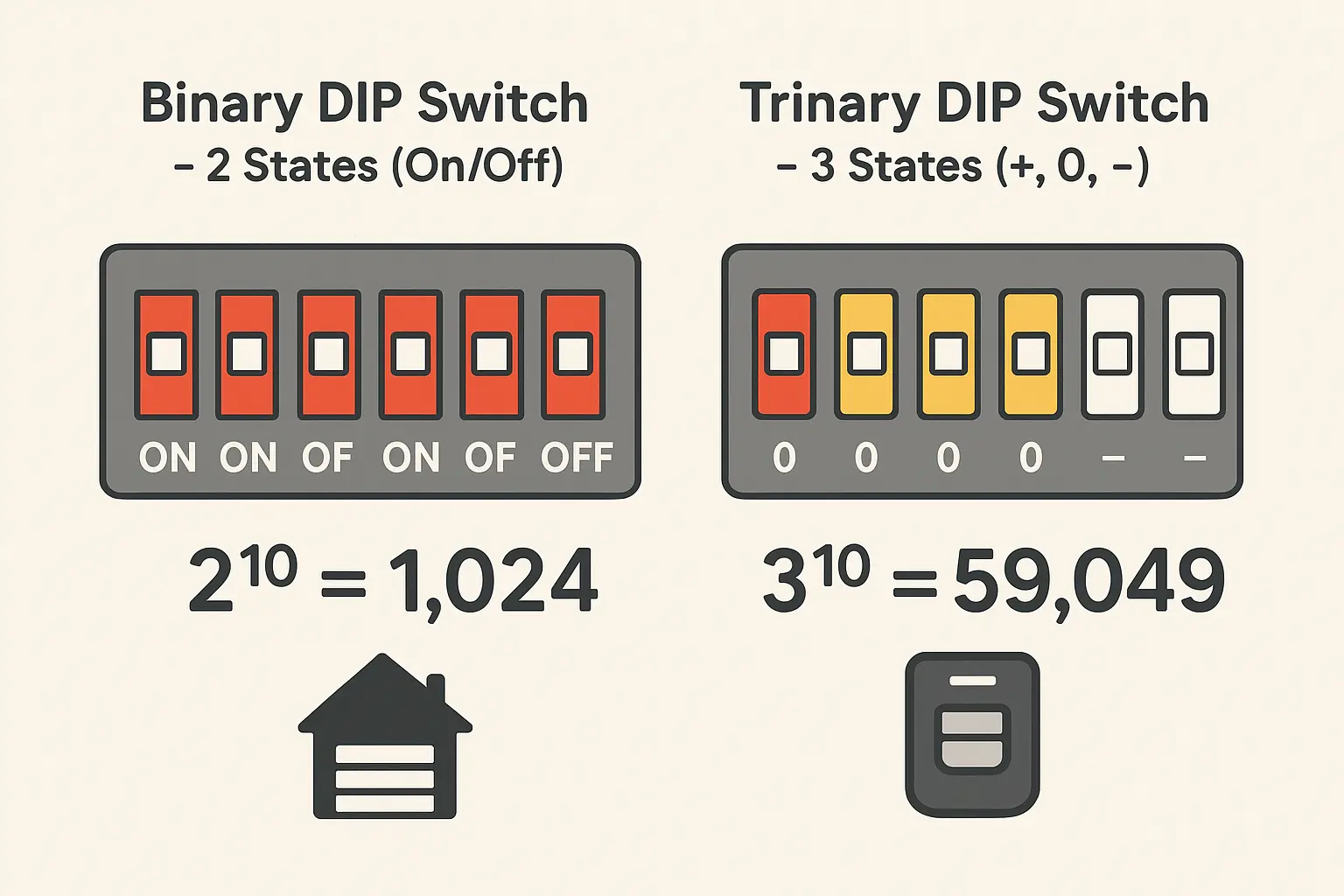
- Binary Switches (2 states: ON/OFF): Standard 10-key systems yield $2^{10}$ (1,024) combinations, while 12-key setups provide just $2^{12}$ (4,096) variations.
- Trinary Switches (3 states: +, 0, -): Used by vintage Chamberlain and LiftMaster models, a 9-switch system yields $3^9$ (19,683) combinations, while a 10-switch system offers $3^{10}$ (59,049).
While fifty thousand combinations might sound secure, mathematically, it is trivial to break.
The 10-Second Hack: How Fixed Codes Are Compromised
Modern hackers do not need physical access or complex gear to exploit this legacy setup. The fundamental fixed code garage door security risk is that the code never changes.
Code Sniffing / Grabbing Explained
With a basic Software Defined Radio (SDR) or hand-held device like a Flipper Zero, anyone standing within 100 feet of your driveway can perform code grabbing. The device sniffs the static signal transmitted when you open your garage, records the fixed code, and replays it later to open your door.
The “OpenSesame” Exploit: Mathematics of the De Bruijn Sequence
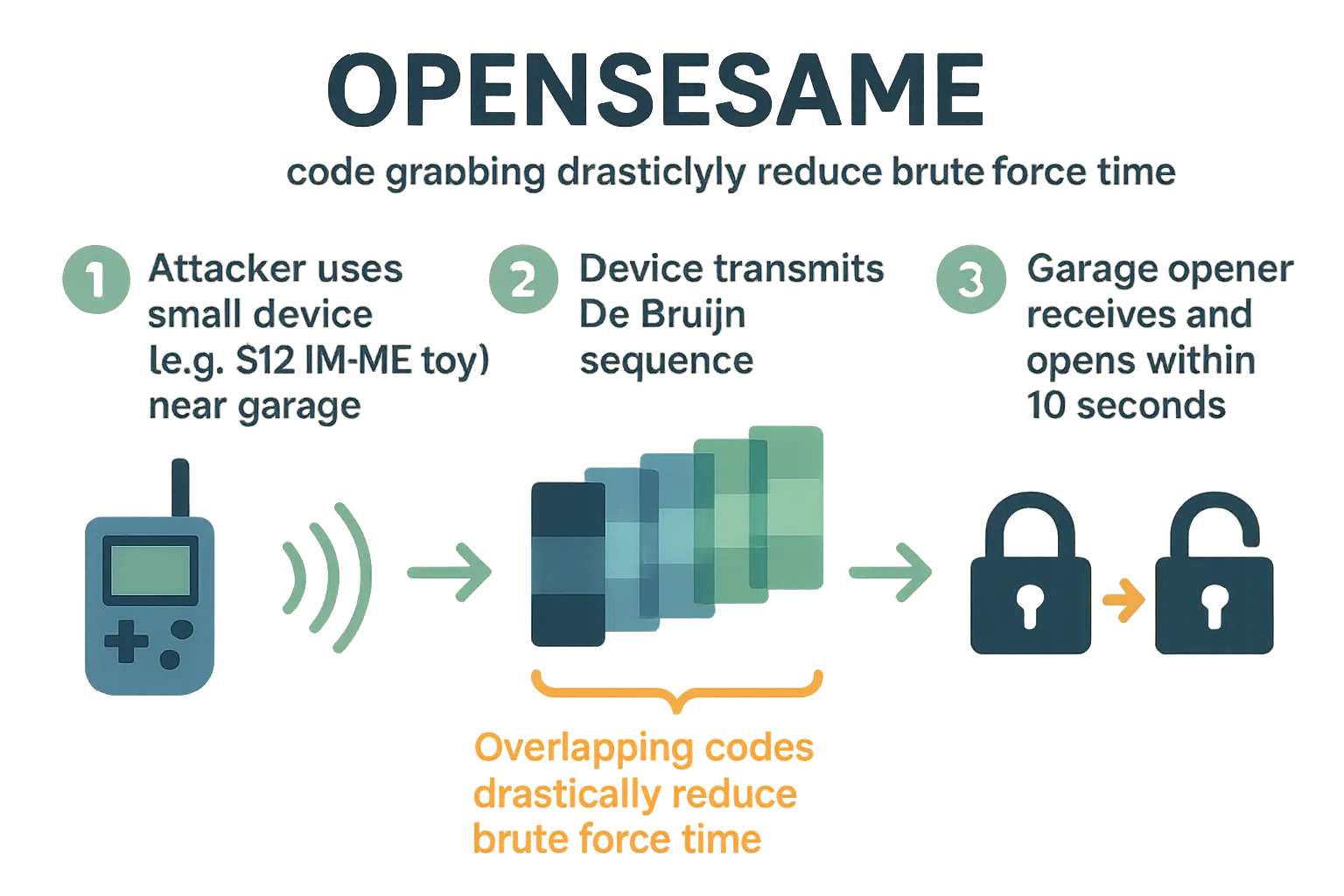
In 2015, security researcher Samy Kamkar released the “OpenSesame” exploit. He demonstrated that a discontinued $12 children’s toy could wirelessly open almost any fixed-code garage door in seconds. Standard brute-forcing—testing each code one-by-one—takes about 40 minutes.
Kamkar applied a mathematical De Bruijn sequence, which allows codes to overlap (e.g., merging 1234 and 2345 into 12345). By transmitting an unbroken stream of overlapping codes and removing transmission delays, he bypassed the system, cracking all 4,096 binary combinations in under 10 seconds.
The Unseen Liability: Pre-1993 Openers and Child Safety
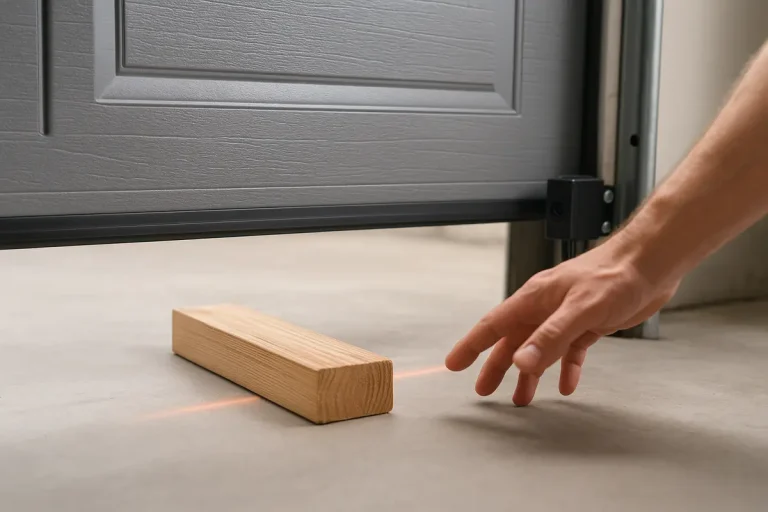
If your opener uses physical dip switches, it is highly likely that your motor predates August 20, 1993. This is the date the UL 325 federal safety mandate went into effect, requiring non-contact photoelectric safety eyes on all residential openers.
Running an opener without these sensors is a massive physical liability. If you are wondering, “will chamberlain garage door opener work without sensors“, the answer is yes, but it is incredibly dangerous to operate. Outdated dip switch systems lack the software and safety logic to stop the door if a child or pet passes underneath.
The Crossroad: What Are Your Upgrade Options?
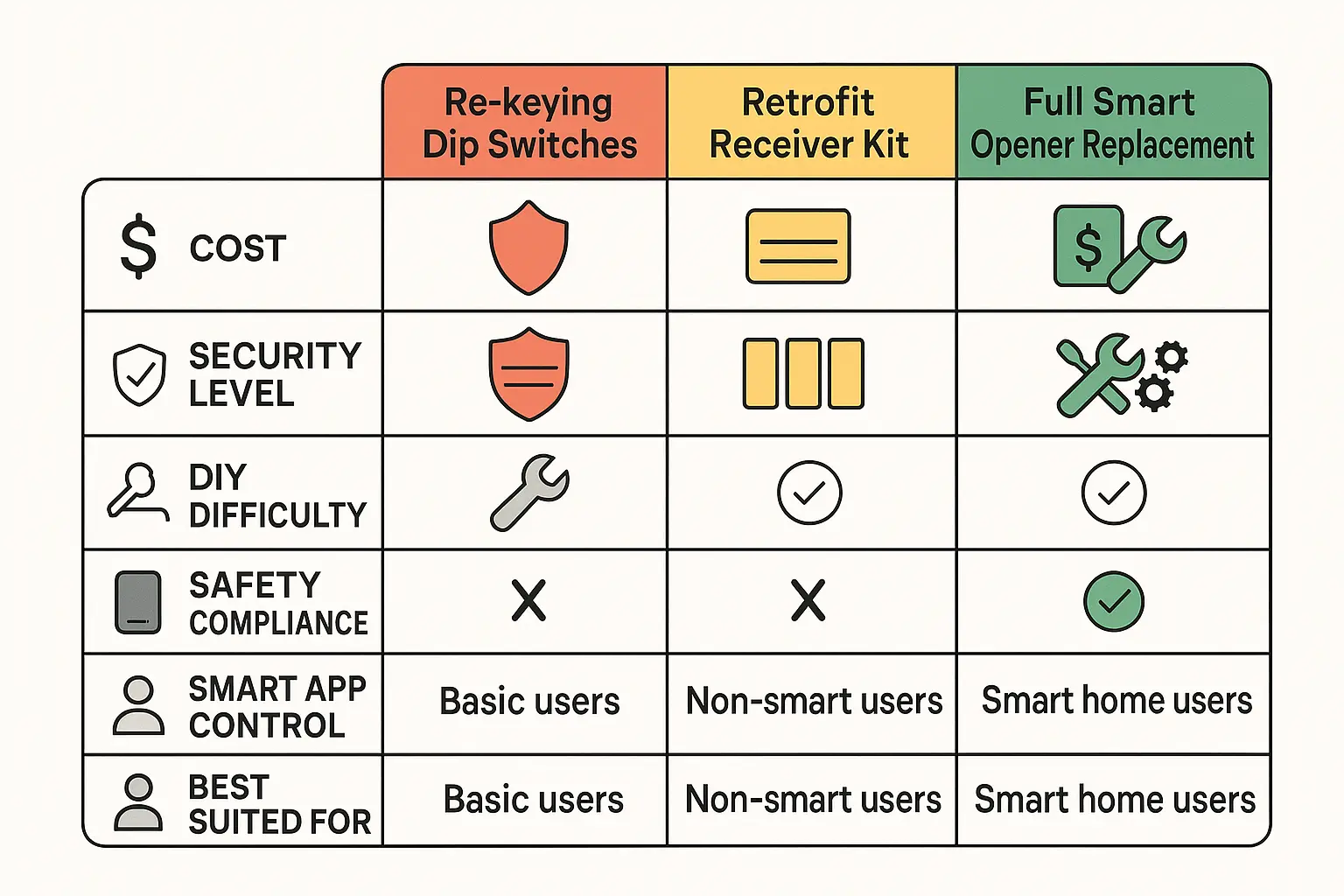
If your home relies on this outdated technology, you have three primary ways forward.
Option A: Changing the Dip Switch Pattern
You can change the physical pin pattern inside the remote. While this prevents neighbors on the same factory-default code from opening your door, it does absolutely nothing to stop code grabbing or brute-forcing.
Option B: Installing an External Rolling-Code Receiver Kit
If your vintage motor is exceptionally quiet, heavy-duty, and otherwise functional, you do not have to throw it away. You can upgrade garage door opener systems by wiring a modern external rolling-code receiver kit (like the Genie GIRUD-1T or LiftMaster 850LM) into your old motor’s low-voltage push-button terminals. This disables the vulnerable fixed-code receiver, upgrading your system to highly secure 128-bit rolling codes.
Option C: Full Smart Opener Replacement
For maximum security and peace of mind, executing a full replacement is the safest choice. Modern rolling code garage door opener systems use dynamic encryption, changing the security key with every single click. Furthermore, knowing when to replace garage door opener hardware ensures your home is fully compliant with modern safety sensor standards and equipped with smart features like myQ smartphone control and real-time camera alerts.
Step-by-Step: How to Safely Upgrade Your System Today
To address this risk today:
- Check Your Remote: Slide open the battery compartment. If you see physical dip switches, check if they are still set to the factory default pattern (e.g., all switches in the middle or UP position). Change them immediately as a temporary stopgap.
- Assess the Safety Sensors: Check if your garage door has functional photo-eye safety sensors at the base of the tracks. If it does not, skip the retrofit and schedule a professional replacement immediately.
- Choose Retrofit vs. Replacement: If the motor is post-1993 and runs well, install a rolling-code retrofit kit. If the motor is ancient, loud, or lacks safety sensors, upgrade to a modern smart belt-drive system.
Frequently Asked Questions
How do I know if my garage door opener has a rolling code?
Look at the motor unit mounted on your garage ceiling. If it has a colored “Learn” button (often yellow, purple, red, or green) instead of a physical block of dip switches, your system utilizes secure rolling-code technology. If you see a physical block of 8 to 12 switches on either the motor or your remote, you have a fixed-code system.
Can I just change my dip switch sequence to make it secure?
Changing your dip switch sequence will prevent random interference from neighbors, but it will not make your system secure. Because fixed-code signals are unencrypted, any modern code grabber or SDR can easily record and replay your new sequence the very first time you use it.
What is the cost difference between retrofitting and full replacement?
A rolling-code retrofit receiver kit typically costs between $45 and $60 and can be wired directly to your existing motor. A full professional garage door opener replacement ranges from $250 to $450 depending on the model, but it includes modern motor technology, built-in smart home integration, backup batteries, and crucial auto-reverse safety sensors.
You May Also Like