




Emergency Commercial Garage Door Service: What Counts as Urgent
Published: Oct 22, 2026
When a commercial overhead door malfunctions outside regular operational hours, facility managers face a high-stress economic calculation: pay an after-hours emergency dispatch premium ($300 to $800+) or wait for standard business hours. Unlike residential garage door issues, commercial overhead door failures threaten operational continuity, worker safety, and regulatory compliance.
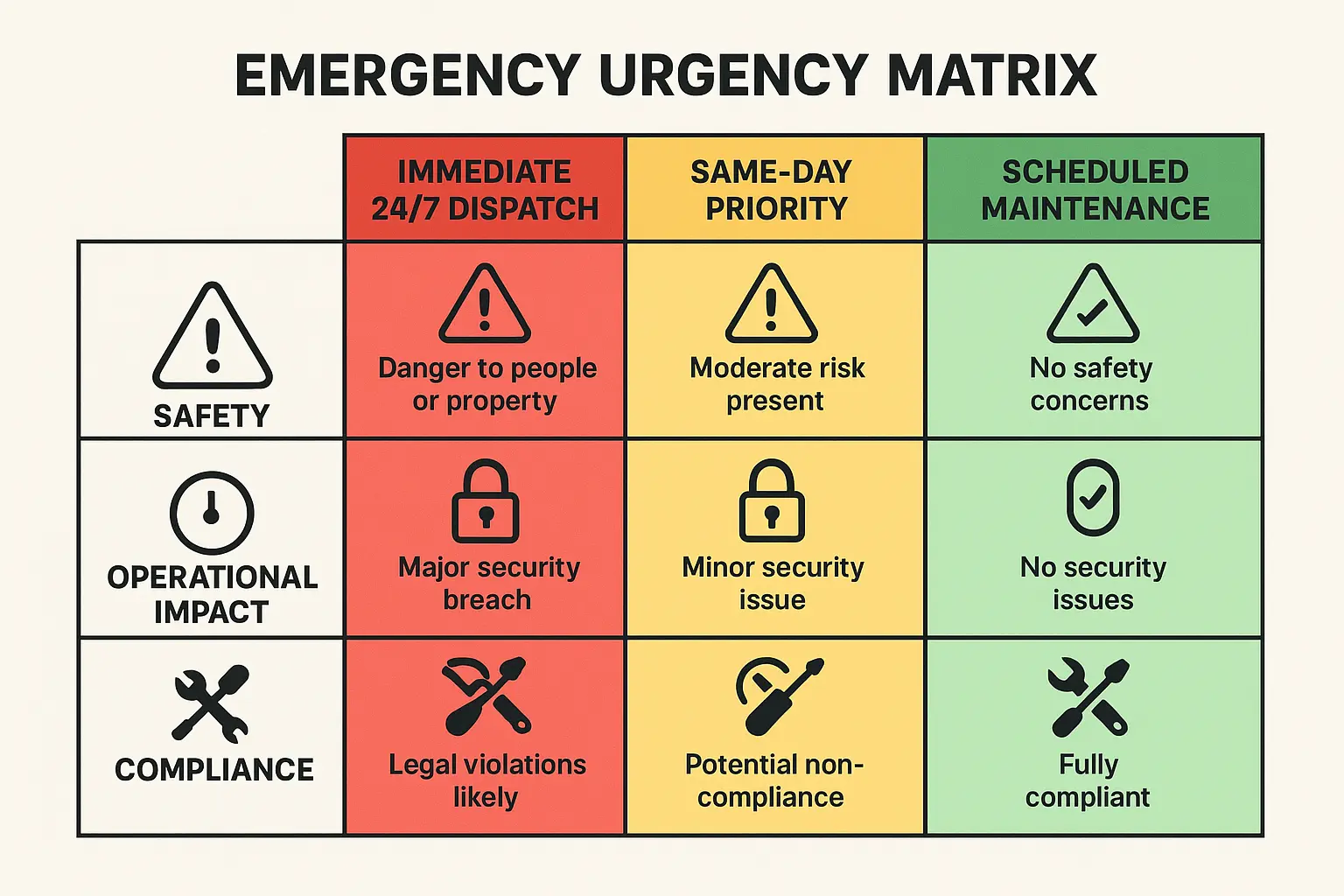
Commercial Emergency Rapid Triage Matrix
To evaluate whether your situation requires immediate intervention or standard scheduling, use this operational triage framework.
When evaluating active system breakdowns, contacting a certified provider for emergency garage door repair ensures instant site stabilization and single-visit resolution.
The 4 Non-Negotiable Commercial Door Emergencies
- Immediate OSHA Safety Hazards: Commercial sectional and steel roll-up curtains weigh between 400 lbs and 1,800+ lbs. A snapped cable or fractured torsion spring represents lethal downward force. Knowing how to tell if your garage door spring is broken is crucial; snapped springs leave doors unsupported, creating severe crushing risks under OSHA workplace regulations.
- Facility Security & Thermal Breaches: A door stuck open overnight exposes high-value inventory to theft and breaches climate-controlled boundaries. Cold-storage and distribution facilities lose hundreds of dollars per hour in temperature decay and HVAC strain when thermal barriers fail.
- Loading Dock Operational Paralysis: Over 65% of commercial track lockouts result from low-speed forklift clipping on the bottom 24 inches of the curtain—displacing the track wall by as little as 1/4 inch. A single blocked loading bay halts logistics schedules and traps freight trucks.
- NFPA 80 Life Safety & Fire Code Violations: Fire-rated overhead doors that fail auto-close drop tests or block emergency egress routes breach local fire codes and NFPA 80 compliance, creating severe legal liability.
For high-security operations, understanding specialized commercial garage door applications for emergency facilities helps maintain compliance during structural failures.
What Can Safely Wait Until Normal Business Hours
Not every mechanical issue justifies emergency rates. You can safely defer service to regular business hours if:
- The door operates smoothly despite minor squeaking or roller friction.
- Cosmetic panel dents exist without altering track geometry or roller movement.
- Auxiliary access remotes fail while manual wall push-stations remain functional.
- Exterior bottom weather-seals show minor cracking without thermal gap exposure.
An overhead curtain garage door stuck halfway, however, indicates physical track binding or cable imbalance and should never be operated manually until professional inspection occurs.
Economics: Emergency Dispatch Fee vs. Inactive Dock Cost
The financial justification for emergency repair comes down to a clear ROI formula:
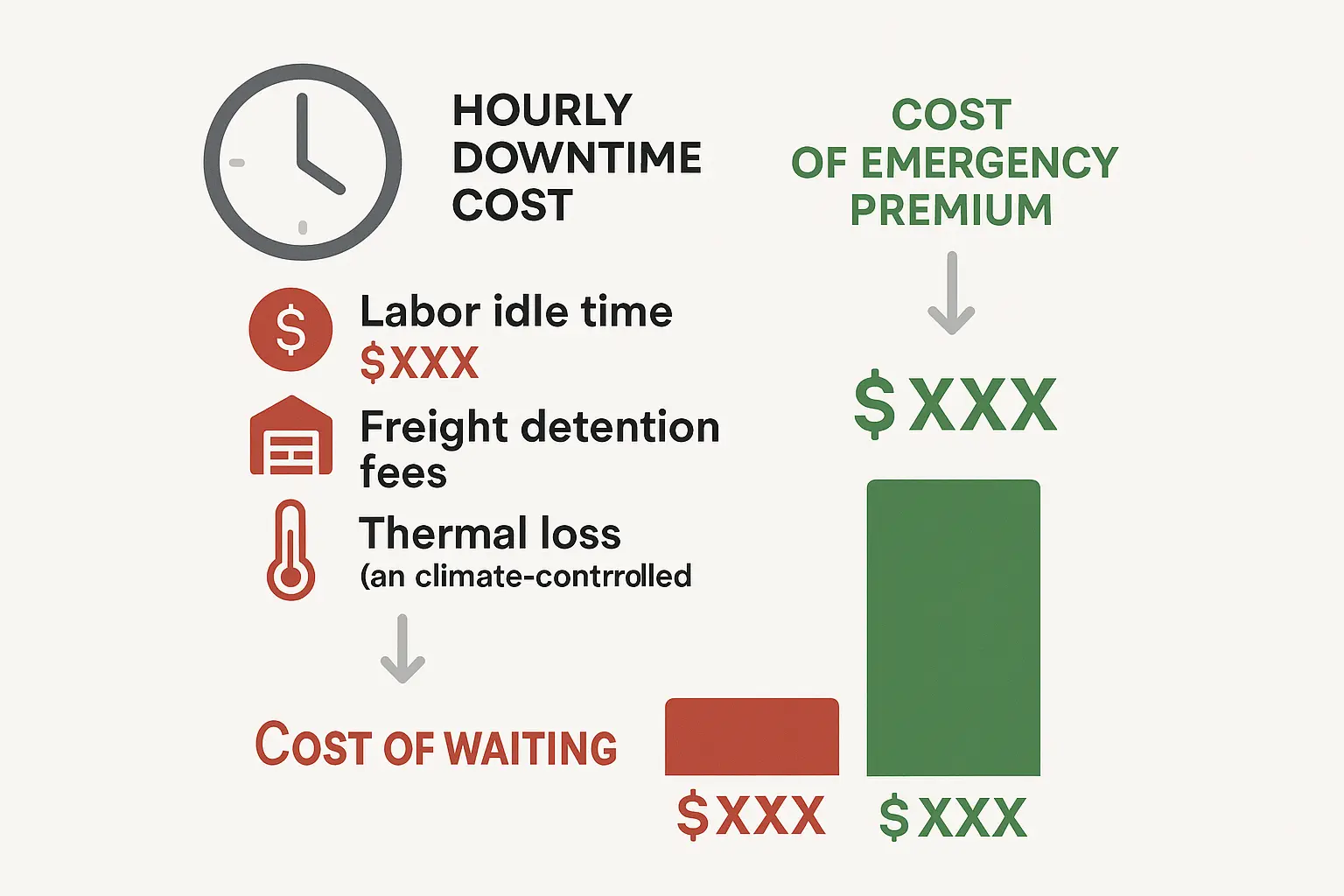
Downtime Loss = (Hourly Idle Labor) + (Freight Driver Detention Fees) + (Thermal HVAC Loss)
An inactive loading dock costs industrial facilities $1,200 to $3,500 per hour in lost throughput and labor idle time. Paying a $300 to $800 emergency premium yields immediate operational ROI within the first 30 minutes of restoration.
Standard commercial springs are rated for 25,000 cycles. In high-traffic distribution centers cycling 75 times daily, standard springs reach total metal fatigue in under 333 days. Upgrading to heavy-duty 100,000-cycle springs extends operational life to over 3.6 years. Prompt garage door cable replacement similarly protects high-cycle assemblies from premature catastrophic failure.
Facility Action Plan & Service Vetting Checklist
While waiting for technicians to arrive, establish immediate site safety protocols:
- Implement Lockout/Tagout (LOTO): Cut power to 3-phase operator motors to prevent automated cycling.
- Establish a Collapse Zone: Secure a 15-foot radius around jammed curtains to protect personnel.
- Stage Site Access: Clear access lanes for incoming commercial service trucks.
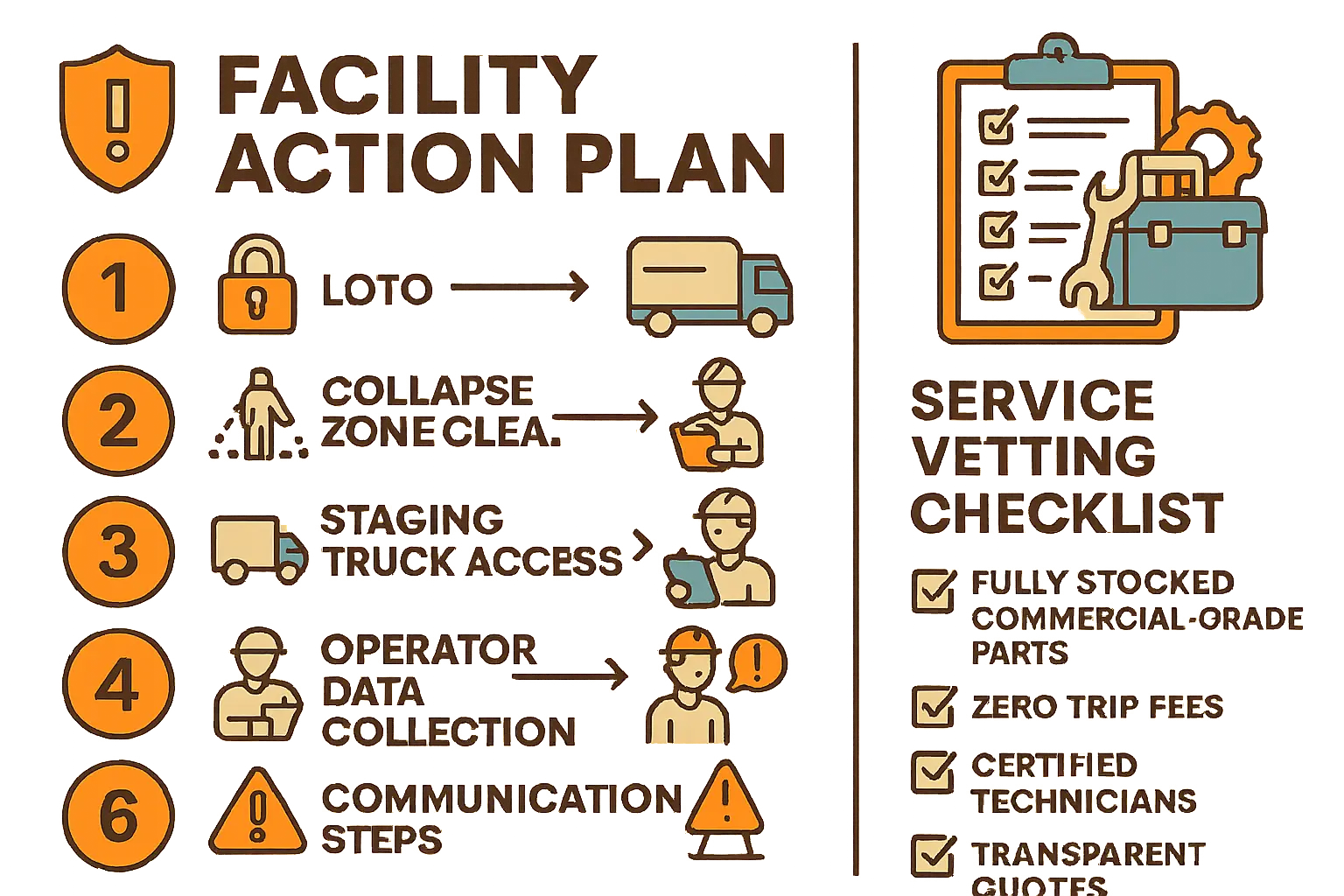
When vetting emergency service providers, require transparent upfront quotes and service trucks stocked with commercial-grade replacement hardware. Experienced specialists like Up & Down Garage Doors provide 24/7 commercial emergency response with licensed technicians to ensure single-trip resolution.
Frequently Asked Questions
Is a broken commercial garage door spring an immediate emergency?
Yes. Commercial doors weigh between 400 and 1,800 lbs. A broken torsion spring transfers extreme unmanaged weight to the cables and operator motor assembly, creating an immediate crushing risk and total operational lockout.
How do low-speed forklift collisions cause complete door lockouts?
Low-speed impacts on the bottom 24 inches of a door curtain displace the track geometry by as little as 1/4 inch. This slight shift causes roller bearings to bind tightly inside the track channels, locking the door securely under spring tension.
What is the average cost of downtime compared to an after-hours emergency fee?
Unplanned dock downtime costs facilities $1,200 to $3,500 per hour in idle labor, driver detention fees, and lost distribution efficiency. An emergency dispatch fee ($300 to $800 premium) pays for itself rapidly by restoring facility throughput.
You May Also Like