





Navigating Discontinued Door Panels: Why Replacing the Whole Garage Door Saves Money
Published: Aug 5, 2026
You notice a deep dent in your bottom garage door panel. Your first thought is straightforward: I’ll just order a single replacement section, hire a pro to swap it out, and be done with it. It sounds like a quick, localized fix that should cost between $350 and $900.
But as you begin hunting for the manufacturer’s sticker and serial number on the inside of your door, you hit a frustrating roadblock. The model is discontinued.
Because garage door manufacturers update, re-engineer, and retire product lines every 5 to 10 years, millions of homeowners find themselves in this exact position. What started as a simple repair search leads to a dead-end of non-existent parts.
However, what looks like a frustrating setback is actually an opportunity to make a high-yield investment. When you weigh the engineering, visual, and safety realities of forcing a repair on an obsolete door, upgrading to a full replacement emerges as the most economically superior, stress-free decision.
Why Garage Door Panels Are NOT Interchangeable (The Engineering Reality)
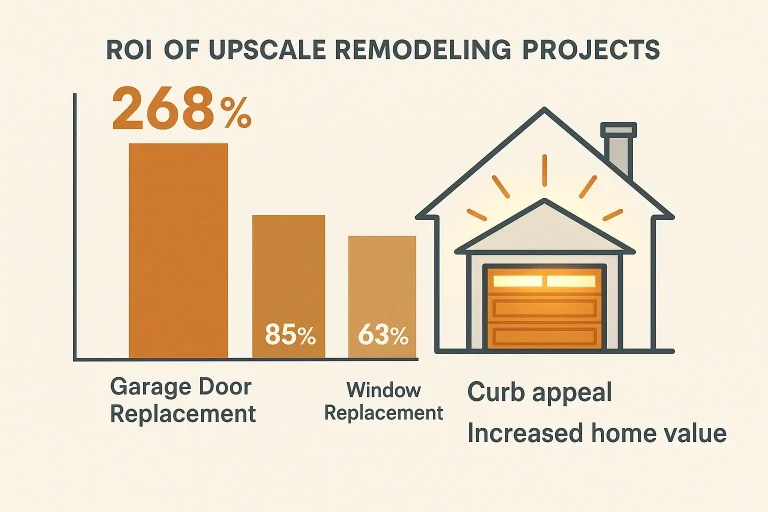
It is highly tempting to look for a third-party panel or a different brand’s section that looks “close enough” online. However, garage doors are highly precise, closed-loop mechanical systems. You cannot mix and match sections from different brands—or even different design generations of the same brand.
Proprietary engineering ensures that panels from different lines cannot safely lock together. The joint systems—whether they use shiplap or tongue-and-groove connections—vary drastically in depth and contour. Steel gauges, hinge placement geometries, and end stile designs differ by fractions of an inch, meaning a mismatched panel will fail to form a weather-tight seal or maintain structural integrity.
Furthermore, manufacturers periodically update their stamping dies. Even if you find a leftover panel with the same model name, the embossing pattern and texture will often be different. Trying to force compatibility usually leads to a damaged garage door replacement process later on. For a closer look at the steps involved in trying to replace a section, you can read our guide on garage door panel replacement.
The Visual Mismatch Penalty (Aesthetic Breakdown)
Even if you manage to track down a rare, dusty warehouse leftover of your discontinued panel, your aesthetic challenges are just beginning.
Years of daily exposure to UV radiation, wind, and rain naturally fade your garage door’s original factory finish. If you install a brand-new panel directly from the factory next to sections that have spent a decade in the sun, the color contrast will be striking.
To hide this mismatch, you would have to professionally prime and repaint the entire door. A high-quality exterior garage door paint job easily adds $500 or more to your total cost, completely wiping out the savings of choosing a repair over a replacement. Instead of settling for a patched, repainted look, exploring modern garage door color ideas with a new installation yields a much cleaner, cohesive exterior.
The High-Tension Danger Zone (Structural & Safety Risks)
Beyond aesthetics, there is a critical mechanical danger to consider. Your garage door panels are not just cosmetic barriers; they are active structural components.
The bottom panel in particular houses the high-tension bottom brackets. These brackets are directly connected to the active spring and cable system, which operates under hundreds of pounds of explosive torque. Attempting a DIY panel replacement on this section is highly volatile and dangerous.
If a replacement panel is not structurally identical, it can twist or bow under pressure. This minor misalignment warps the track system, causing a bent garage door track that jams the door. It also accelerates wear on your moving parts, requiring an immediate garage door roller replacement to keep the door moving, and puts uneven stress on your springs, which can lead to a sudden, hazardous broken garage door spring.
THE DECISION MATRIX: Repairing vs. Full Replacement Cost Comparison
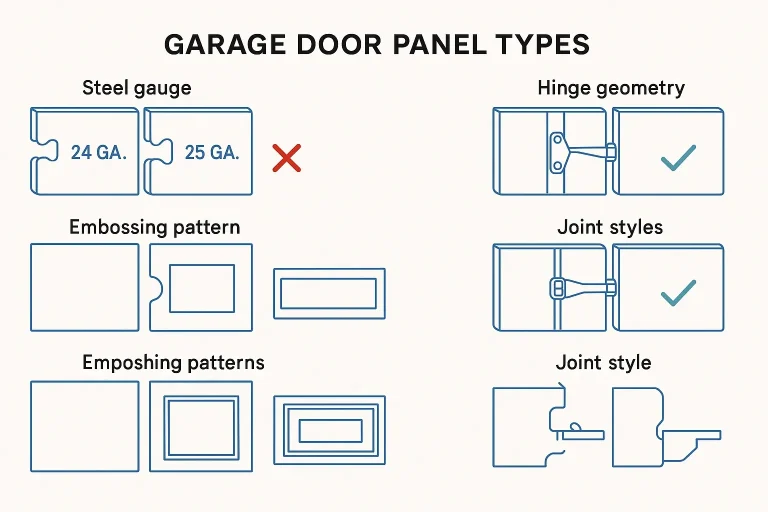
While a single panel repair runs $350–$900, many homeowners discover they actually need to replace two damaged panels. Replacing multiple panels typically costs $1,720–$2,580, driven by professional labor rates that average $63/hour.
Given that an entirely new, modern double steel door starts around $2,400–$3,400, pouring thousands of dollars into repairing an obsolete, structurally aged door system represents negative economic value.
The Financial Masterstroke (268% ROI & Curb Appeal)
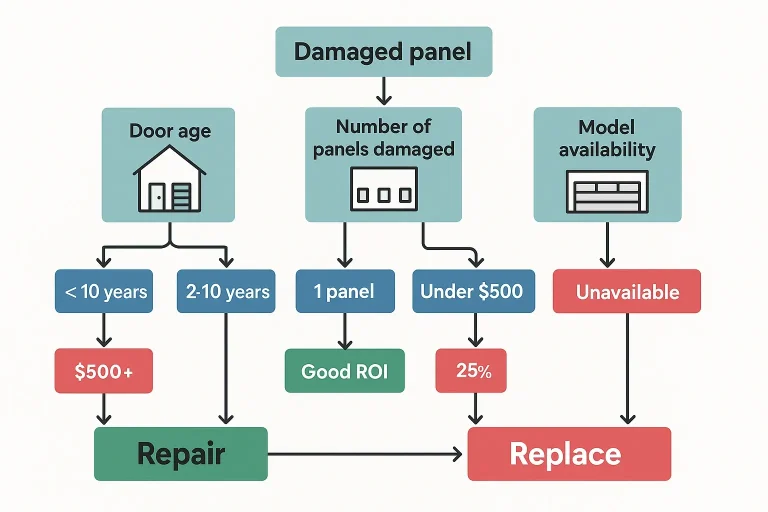
According to the latest Cost vs. Value Report, a complete residential garage door replacement delivers an incredible 268% return on investment. This means upgrading your door more than doubles your initial investment in immediate home resale equity, outperforming almost all other upscale remodeling projects.
Additionally, upgrading allows you to install modern, energy-efficient garage doors that lower heating and cooling bills. While the EPA explicitly clarifies that residential garage doors do not qualify for federal energy-efficiency tax credits, the daily utility savings and major curb appeal upgrade make it highly lucrative. By looking at the pros and cons of garage door materials and finding the ideal style of your garage door, you can choose an option that elevates your home’s security, efficiency, and market value.
Frequently Asked Questions
Can you buy replacement panels for a discontinued garage door?
Generally, no. Because manufacturers update their joint profiles, steel gauges, and stamping dies, new panels will not align or seal properly with discontinued models.
How much does garage door panel replacement cost?
Replacing a single panel typically runs between $350 and $900. If you have to replace multiple panels, the price ranges from $1,720 to $2,580, making a full replacement a much better financial choice.
Do energy-efficient garage doors qualify for federal tax credits?
No. The EPA’s Energy Star program does not have an active specification for residential garage doors, so they do not qualify for federal energy-efficiency tax credits. However, their high R-value still delivers notable monthly utility savings and a 268% return on investment at resale.
Take the Hassle-Free Path to a Beautiful, Secure Home
Instead of spending weeks searching for non-existent parts for an obsolete door, invest in a modern, reliable system that enhances your home’s safety and value.
At Up & Down Garage Doors, our family-owned business brings over 15 years of industry experience and a personal, honest approach to every project. We operate across multiple states with 24/7 availability and fair, transparent pricing. Contact us today to schedule your upgrade consultation and get a precise, upfront quote.
You May Also Like
The Sourcing Trap: Risks of Replacing Discontinued Garage Door Panels
It is a frustratingly common scenario: you back out of your driveway a bit too quickly, or a rogue storm flings a heavy branch, leaving a deep crease in a single garage door panel. Naturally, your first instinct is…
Published Date: Aug 3, 2026
How to Insulate Garage Door Panels on Old or Odd-Sized Models
You’ve seen the videos. Someone grabs a neat, pre-packaged insulation kit from a big-box store, spends an afternoon snapping panels into place, and voilà—a perfectly insulated, standard-sized metal garage door. It…
Published Date: Jul 1, 2026
When a Bent Garage Door Panel Needs Replacement vs. Repair
It happens in a split second. A moment of distraction while backing out, an icy patch on the driveway, or a misplaced sports ball—and now there’s a noticeable bend in your garage door. The first feeling is…
Published Date: Jun 17, 2026