




Why Weather and Environment Force Your Garage Door to Reverse
Published: Sep 22, 2026
You press the wall button or remote, the garage door begins its downward travel, and suddenly—it reverses back up, with the opener lights flashing. It is an incredibly frustrating scenario. While physical obstacles are easy to spot and remove, some of the most common causes of a reversing garage door are completely invisible: environmental shifts.
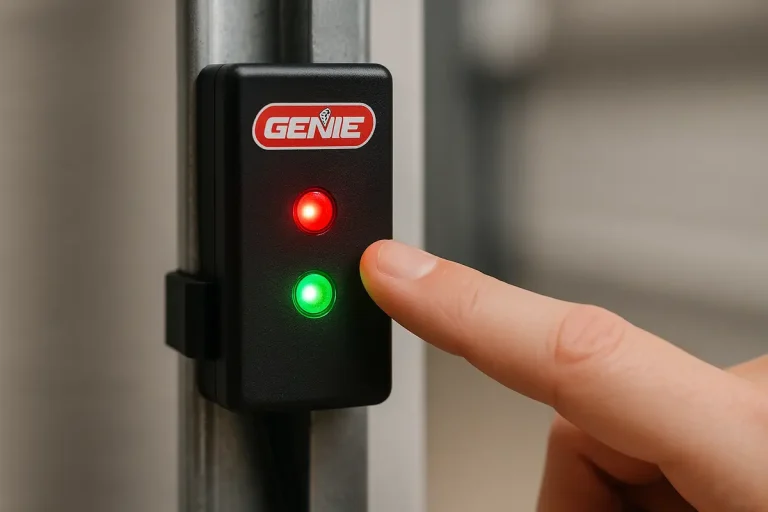
From blinding afternoon sunlight to sub-zero freeze cycles, external conditions constantly act on your system’s physical and electrical components. When these elements disrupt the system, homeowners are often left stranded. If you are experiencing an immediate lockout, look at your safety eyes. If there is no green light on garage door sensor, the safety loop has been broken. To bypass this in an emergency, press and hold the wall-mounted button continuously until the door is completely closed.
Anatomy of Sun Blinding: The Science of Infrared Saturation
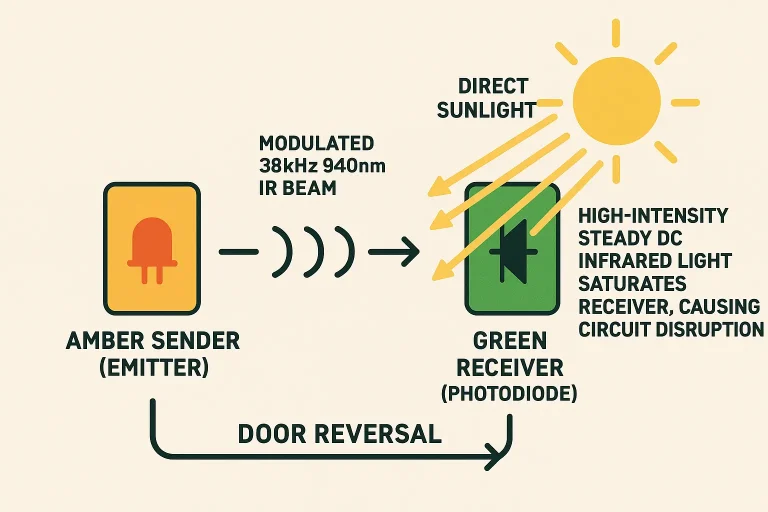
Modern garage door openers rely on a continuous, invisible infrared (IR) beam emitted at a 940nm wavelength to detect obstructions. The sender unit (which usually displays an amber LED) projects this modulated 38kHz pulse to the receiver unit (green LED).
However, during seasonal shifts, the sun can align perfectly with the lens of the receiving eye. High-intensity ambient solar radiation saturates the photodiode inside the green eye. This “blinds” the receiver, mimicking a physical obstruction and triggering a safety reverse garage door response.
To resolve this issue, avoid temporary cardboards that easily disintegrate in the wind. Instead, install specialized OEM sun blockers or swap the physical positions of the sensors, placing the green receiving eye on the side of the track that receives the most shade during peak sun hours.
Winterization Mechanics: Thermal Contraction and Viscosity
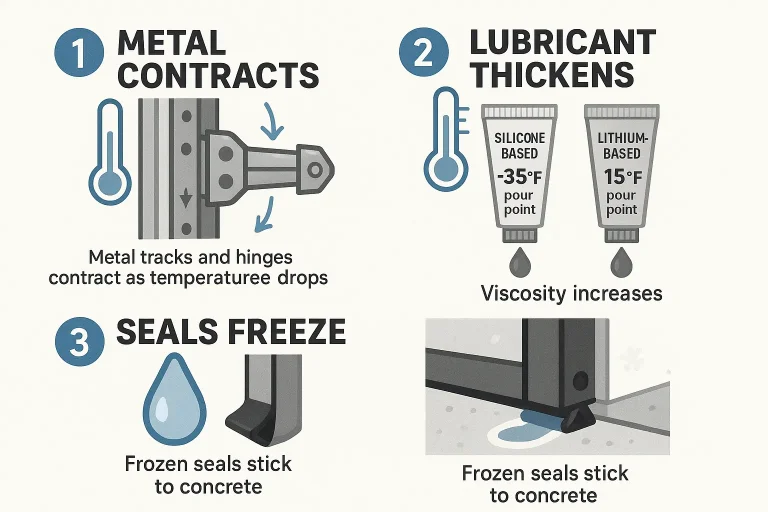
When temperatures plunge below freezing, your garage door’s physical structure undergoes massive thermal stress. Steel tracks, rollers, and springs contract, altering alignment and increasing physical friction. Simultaneously, standard grease thickens to an adhesive-like consistency. This combined mechanical resistance tricks the opener’s internal force-limit sensors, causing the motor to think it has struck an object and trigger a protective reverse.
Understanding what wears out in a garage door during extreme cold helps prevent total structural failure. Always use the best garage door lubricant for cold weather—specifically low-viscosity, silicone-based sprays that remain fluid in sub-zero climates, rather than heavy grease.
Additionally, cold temperatures can cause the bottom rubber seal to freeze directly to wet concrete. Apply a light coat of silicone spray to the weather seal to prevent tears when the door lifts, realizing what are the benefits of adding weather stripping to my garage door? in maintaining thermal stability and preventing sticking.
The Micro-Interference Loop: Spiderwebs, Condensation, and Dust
Often, a garage door intermittently will not open or close because of microscopic obstructions. Tiny spiderwebs spun across the brackets collect dust, pollen, and morning dew. This debris acts like a prism, scattering the 940nm light beam.
Rapid temperature shifts also create condensation directly on cold lenses, disrupting the signal. Knowing how to clean garage door sensors with a microfiber cloth and a gentle wipe-down prevents these micro-interfering loops from shutting down your system.
Bypassing Sensors: Legal Liability and Insurance Realities
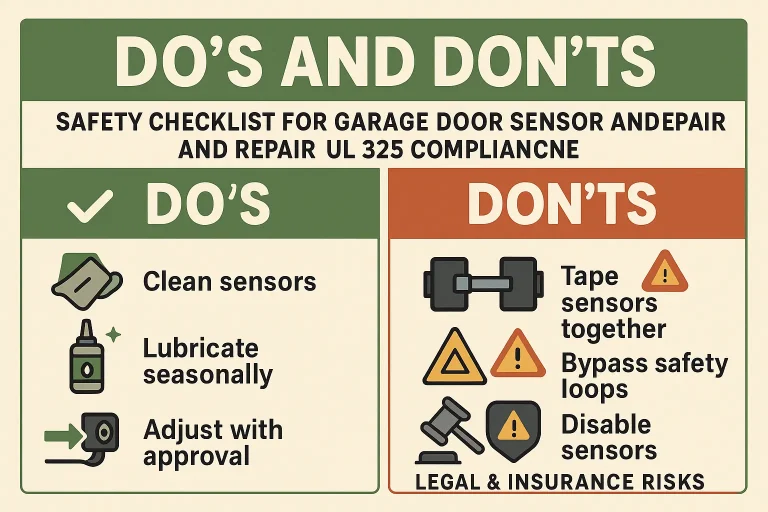
When faced with recurring environmental failures, many homeowners look up how to bypass garage door sensors. Some resort to unsafe hacks like taping the safety eyes together or cutting the wires. However, federal law under the Consumer Product Safety Improvement Act (incorporating UL 325 standards since January 1, 1993) strictly mandates a functional secondary safety reverse system on all residential garage door openers.
Attempting to make a will chamberlain garage door opener work without sensors functional by permanently disabling safety features is highly dangerous. This modification voids homeowners’ insurance, leaving you fully liable for property damage or personal injuries resulting from a failing, non-compliant door.
Smart Upgrades: Bypassing Optical Vulnerabilities Entirely
For ultimate weather resistance, modern homeowners are looking beyond standard optical safety loops. By integrating smart home hubs like Hubitat with Z-Wave relays (such as the Zooz ZEN17) and rugged magnetic tilt sensors, you can create a highly reliable, dual-layered system. Direct serial integrations like Ratgdo allow local, lag-free status monitoring of your opener’s internal state. This lets you track physical open/close cycles safely and reliably, even when external weather compromises your optical sensors.
Frequently Asked Questions
Why does my garage door open perfectly but reverse when trying to close?
This is almost always a safety eye issue. The safety system allows the door to open freely, but any signal interruption during closing—such as optical sun blinding, misaligned sensors, or a clogged garage door obstruction sensor—will force the door to reverse to prevent entrapment.
How does extreme cold weather trigger a safety reversal?
Cold weather contracts metal tracks and thickens standard lubricants. This creates elevated physical friction along the tracks, which causes the motor to exceed its preset force limit. The system interprets this heavy resistance as an obstruction, immediately halting and reversing the door.
Is it safe to temporarily tape the safety sensors together to close the door?
No. While taping the sensors together tricks the system into closing, it completely disables the entrapment protection mechanism. If a pet, child, or vehicle passes under the door while closing, the door will not stop, risking catastrophic damage or injury and exposing you to extreme legal and financial liability.
You May Also Like