





Reflective Foil Insulation for Garage Doors: Beyond the R-Value Myth
Published: Aug 17, 2026
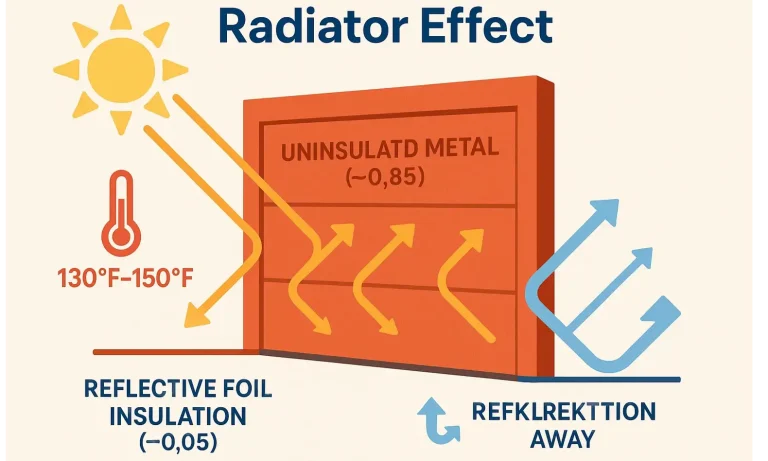
Under the intense heat of the summer sun, uninsulated steel garage doors behave exactly like giant radiators. They absorb solar radiation and heat up to 130°F–150°F, turning your garage into a suffocating oven. While many homeowners look for easy retrofits, the sheer volume of conflicting marketing claims, DIY “hacks,” and building science debates can make choosing the right material incredibly confusing.
Selecting the right garage door insulation is about understanding the actual physics of heat transfer. Cheap packaging bubble wrap is not only ineffective but is also a severe fire hazard. True, engineering-grade reflective foil insulation is a highly structured material designed to intercept radiant heat before it can warm your garage.
If you are trying to figure out how to insulate a garage door effectively, you must first separate structural marketing myths from building science realities.
The Core Controversy: Debunking the R-Value Myth
The biggest point of confusion in reflective insulation is the difference between nominal material R-value and system R-value.
- Nominal R-Value (Product Only): The physical material itself is incredibly thin. A single bubble layer is R-1.1; double bubble ranges from R-1.5 to R-2.0; and 2mm–6mm closed-cell foam cores sit around R-1.5 to R-2.5.
- System R-Value (Assembly): Manufacturers often claim values like R-8 or R-10. However, these numbers are achieved under ASTM C1363 laboratory standards, which assume a perfectly sealed, unventilated 1.5-inch to 3.5-inch dead air space.
In a real-world retrofitted garage door, you cannot achieve a perfectly sealed air cavity. Therefore, expecting a true conductive garage door insulation r value of R-8 from a thin foil roll is unrealistic.
The secret is that reflective foil is not designed to stop conductive heat like thick foam board. Instead, it is a high-efficiency radiant barrier. While a standard steel door has a high emissivity of 0.80 to 0.90—meaning it radiates up to 90% of its heat inward—pure aluminum foil has an emissivity of 0.03 to 0.05. It stops 95% to 97% of radiant heat from ever entering your space.
Deep Dive: Material Compositions Compared
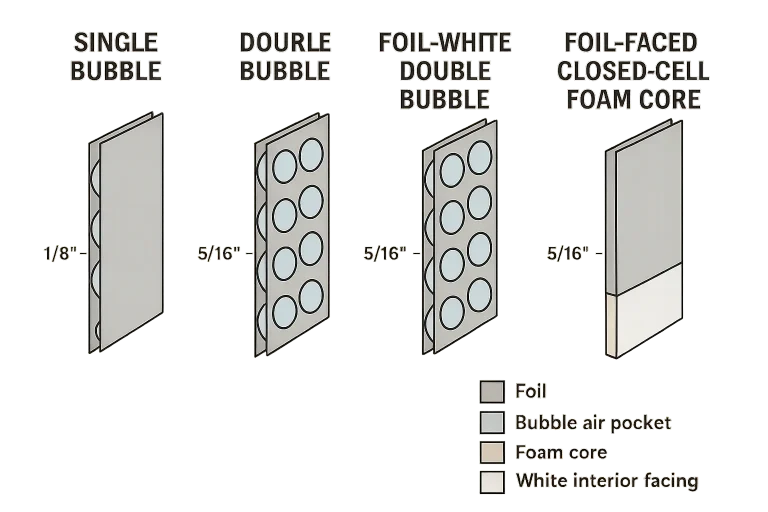
When comparing your options, you will encounter four primary reflective foil formats. Your choice depends on your local climate, budget, and aesthetic preferences.
- Foil-Foil Single Bubble (1/8”): A single layer of polyethylene bubbles sandwiched between two sheets of radiant foil. It is highly flexible and budget-friendly, making it ideal for tight commercial roll-up door channels.
- Foil-Foil Double Bubble (1/4”): Two layers of air bubbles that provide a stronger thermal break and prevent condensation.
- Foil-White Double Bubble (1/4”): Features reflective foil on one side (which must face the steel door skin) and a clean white polyethylene finish on the other. This interior white face bounces light, making dark garages feel brighter and professionally finished.
- Foil-Faced Closed-Cell Foam Core (2mm–6mm EPE/XPE): Instead of bubbles, this uses solid extruded foam. It is highly puncture-resistant, will not pop over time, and delivers superior sound and vibration dampening.
To see how these foil options stack up against bulk materials like fiberglass or EPS, review our comprehensive guide on insulated garage door materials comparison.
Weight Dynamics and the Air Gap Imperative
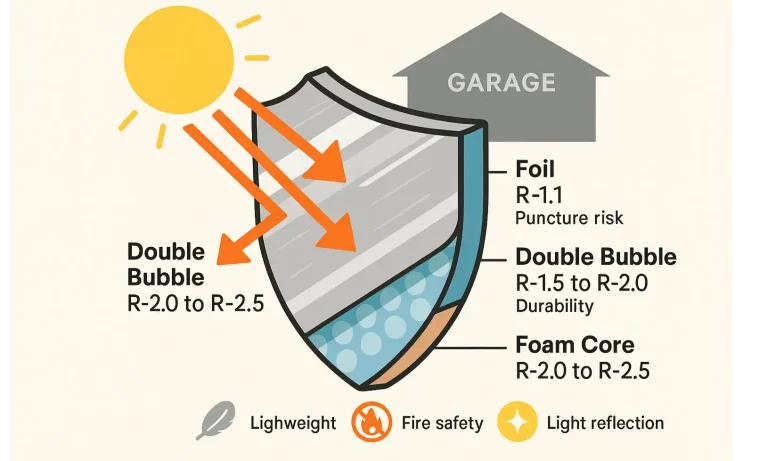
Unlike heavy polystyrene garage door insulation boards—which can add 15 to 25 pounds to your door and throw your torsion springs out of balance—foil systems are incredibly light. A full double-car garage door kit weighs less than 5 pounds. This means you do not have to worry about how to adjust your springs or risk damaging your automatic opener. If you are curious about system mechanics, learn more about how does a garage door spring work.
To make any radiant barrier work, you must maintain an air space (ideally 1/16” to 1/2”) between the foil and the metal door skin. If the foil is in direct, compressed contact with the hot metal, the heat will simply conduct straight through it, rendering the reflective surface useless. Using double-sided acrylic foam tape lines or tucking the material into the door’s built-in panel channels naturally creates this critical air gap.
Fire Safety and Environmental Protection
Never use everyday packing bubble wrap to insulate a garage door. It lacks UV inhibitors and will degrade quickly under solar heat. More importantly, it is highly flammable.
Per International Residential Code (IRC) Section R316, any exposed insulation on a residential garage door must carry an ASTM E84 Class A or Class 1 fire rating (Flame Spread Index $le$ 25, Smoke Developed Index $le$ 450). Compliant foil systems are engineered with fire-retardant additives that will not drip flaming plastic or accelerate a fire.
Additionally, introducing a vapor-barrier material to a metal door can raise concerns about moisture. Utilizing high-quality double-bubble barriers alongside proper ventilation serves as one of the best garage door condensation solutions available. To maximize your energy savings, pair your foil barrier with high-quality inside garage door weather stripping to seal out hot drafts completely.
Reflective Foil FAQs
Will reflective foil help in freezing winters?
Reflective foil is highly efficient at blocking incoming summer radiant heat, but it provides minimal resistance against winter conduction. If your primary goal is keeping a freezing garage warm, a thicker bulk insulation material is a better choice.
Can I install reflective foil on commercial roll-up doors?
Yes. Because roll-up doors wrap around a barrel at the top of the opening, rigid foam boards cannot be used. Thin, flexible single-bubble foil or 2mm foam core insulation fits perfectly into these narrow channels. This makes them a highly effective option for commercial insulated roll up garage doors.
Does foil insulation help reduce garage noise?
While bubble-core foil offers very little acoustic dampening, a foil-faced closed-cell EPE foam core is excellent at deadening high-frequency vibrations. For maximum soundproofing, a heavy, dedicated soundproof garage door is recommended.
Step Into a Cooler Garage
If your garage faces direct afternoon sun, installing a Class A fire-rated double-bubble or foam-core radiant barrier is one of the most effective, lightweight, and cost-efficient upgrades you can make. Ready to transform your hot garage into a comfortable, functional workspace? Contact the local experts at Up & Down Garage Doors to find the perfect professional insulation or door replacement solution for your home.
You May Also Like
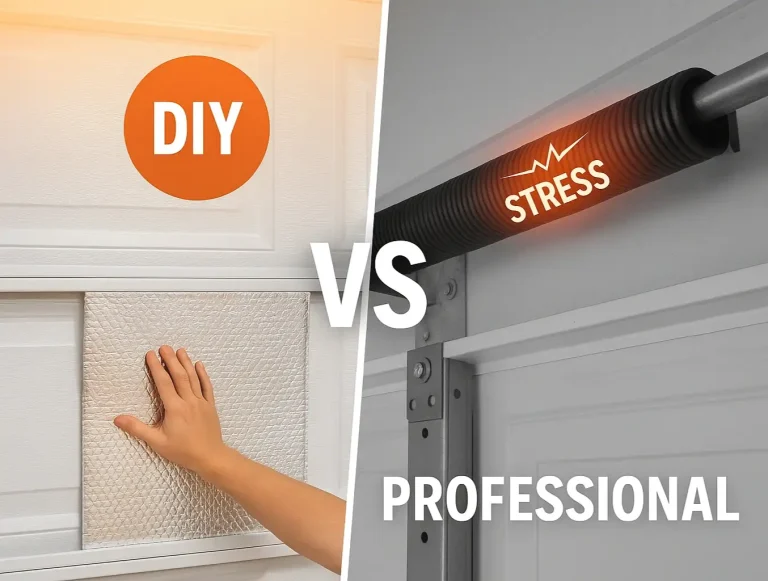
Reflective Foil Garage Door Insulation Installation: DIY vs. Professional
Stepping into your garage on a midsummer afternoon shouldn't feel like stepping into an oven. For many homeowners—especially those with electric vehicles whose lithium batteries charge most efficiently between 50°F…
Published Date: Aug 10, 2026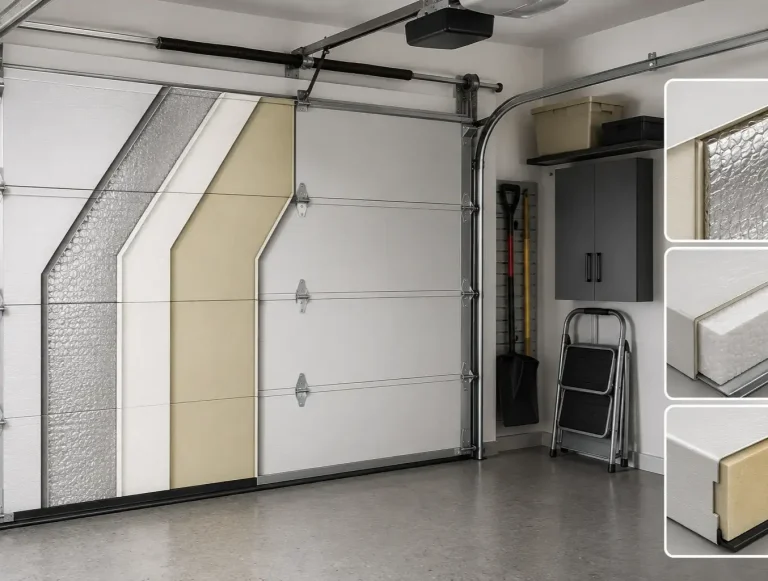
Space-Saving Insulation Solutions for Garage Doors in Compact
You’ve meticulously designed your compact, energy-efficient home. Every square foot is optimized, every window is triple-paned, and your walls have the perfect thermal envelope. But there’s a giant, uninsulated hole…
Published Date: Jun 26, 2026
The Best Garage Door Solutions for Small Spaces and Compact Homes
The trend towards smaller homes is becoming increasingly common, but that doesn’t mean you have to sacrifice function or style. With thoughtful planning and the right garage door installation choices, you can have an…
Published Date: Jun 6, 2025