





Modernizing Facility Throughput: A Guide to Smart Commercial Garage Door Automation
Published: Jul 20, 2026
For a modern operations director or facilities manager, a warehouse door is no longer just a piece of isolated metal. Today, it functions as an intelligent cyber-physical node within your logistics flow. When a single bottleneck at the loading dock can disrupt your entire supply chain, upgrading to smart automated systems is a calculated investment in efficiency, climate control, and safety.
Evaluating a commercial garage door replacement requires looking beyond physical specifications to examine how kinematics, sensor logic, and smart building integration work together. This guide analyzes these components to help you choose the best system for your facility.
Mechanical Kinematics: High-Speed Fabric vs. Rigid Industrial Doors
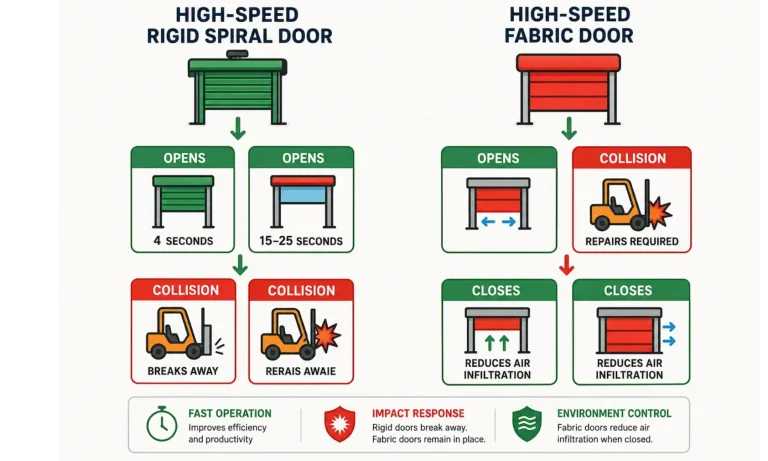
Standard overhead sectional doors take 15 to 25 seconds to complete an open-and-close cycle. In a busy logistics hub, this slow pace causes substantial energy loss. High-speed doors operating at speeds of 100 to 125 inches per second complete a cycle in under 4 seconds, reducing ambient air exchange by 70% to 80%. This faster performance directly translates to thousands of dollars in monthly HVAC savings for climate-controlled facilities.
When evaluating fabric vs rigid high-speed doors, consider your operational priorities:
- Rigid Spiral Doors (e.g., Rytec): These use durable rigid aluminum slats that offer strong physical security and high-speed operation (up to 100 inches per second). They are ideal for high-visibility commercial parking and automotive retail spaces where security is a priority.
- Flexible Fabric Roll-Up Doors (e.g., Rite-Hite FasTrax): These doors feature soft bottom edges and flexible tracks designed to withstand forklift impacts. Technologies like the TRUE Auto Re-feed™ system automatically guide a displaced door back into its tracks after a collision, eliminating downtime.
If your facility prioritizes thermal efficiency and collision recovery over physical security, understanding the advantages of high performance doors can help you select the ideal high-speed system.
Decoupling the Sensor Grid: How to Eliminate Ghost Cycles and Maximize Safety
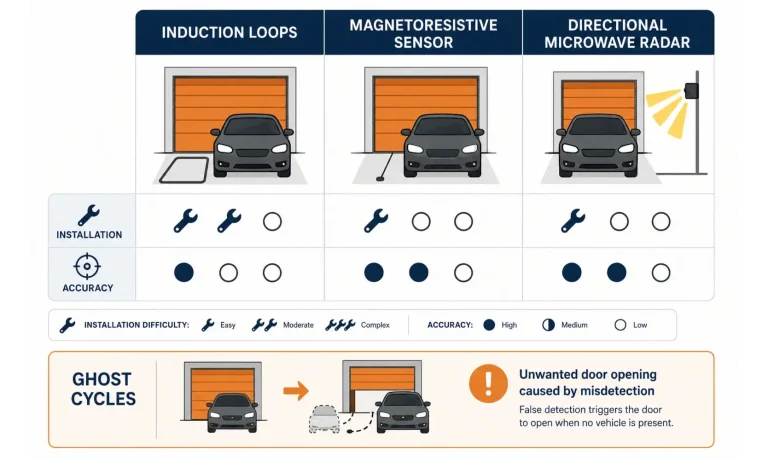
A high-performance door is only as smart as its sensor grid. Poorly configured sensors trigger “ghost cycles”—doors opening when a forklift drives parallel to the door instead of through it. These unnecessary cycles accelerate wear on components and increase thermal loss.
Selecting and configuring the right sensors can resolve these issues:
- Induction Loops vs. Magnetoresistive Probes: Traditional induction loops require deep rectangular saw cuts in your concrete floor. Modern single-cut magnetoresistive sensors require only a single saw line, reducing installation labor costs by 60% while delivering similar magnetic field disruption sensing.
- Directional Microwave Radar: Unlike basic motion sensors that trigger on any nearby movement, directional radar can be tuned to ignore parallel or receding traffic. This single feature can reduce unnecessary door cycles by up to 40%.
- Safety & Compliance: Keeping your facility compliant with UL 325 and ANSI/DASMA 102 standards is simple with multi-beam light curtains. These generate a dense infrared safety field up to six feet high, providing better protection than traditional single-beam photo eyes.
When configuring these triggers, choosing the right method for activating commercial garage doors ensures your warehouse traffic flows smoothly without compromising building security.
Smart Operators & IoT: Integrating Commercial Doors into PLC and BMS Networks
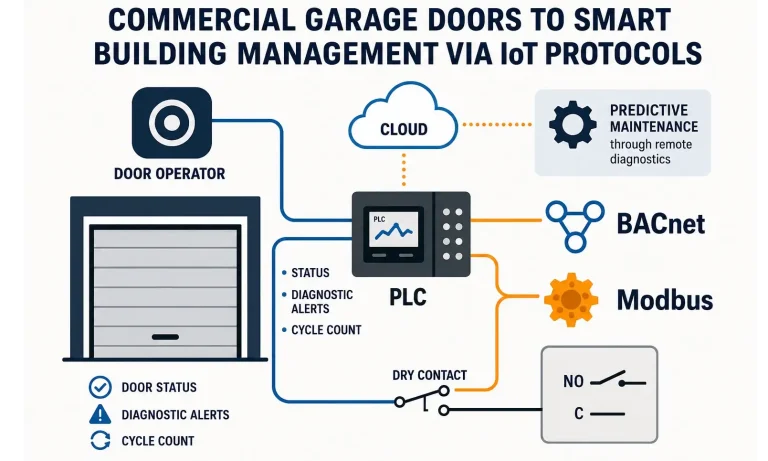
Modern industrial facility design integrates physical barriers with digital control networks. High-cycle door operators, such as the liftmaster commercial garage door opener MAXUM series, feature smart DC motors with variable speed profiles and built-in network interfaces.
Integrating your doors into your facility infrastructure improves performance across three key areas:
- BMS Integration via BACnet and Modbus: Connecting your door controllers to a Building Management System (BMS) allows you to monitor door status, cycle counts, and thermal anomalies in real time.
- Programmable Logic Controller (PLC) Synchronization: Integrating door dry contacts with your warehouse logistics automation ensures safety. For example, a PLC can keep a green light red for a forklift operator until the door is fully open.
- Predictive Maintenance: Platforms like MyQ Facility track cycle logs and alert you to maintenance needs before a breakdown occurs, helping you manage high cycle automatic door systems and reduce emergency repair costs.
Frequently Asked Questions
Can we integrate high-speed doors with our existing PLC systems?
Yes. Most industrial doors utilize dry contact relays that connect directly to standard PLCs. Modern smart operators support BACnet and Modbus protocols, allowing you to integrate door metrics directly into your Building Management System (BMS).
How do modern doors recover from forklift collisions?
Flexible fabric doors use breakaway tracks (such as the TRUE Auto Re-feed™ system). When hit, the door curtain releases from its guide tracks to prevent structural damage and automatically re-feeds into the tracks on the next cycle, keeping your operations moving.
What is the ROI of upgrading to a smart, high-speed door?
By reducing cycle times from 20 seconds to under 4 seconds, high-speed doors reduce HVAC air-exchange losses by 70% to 80%. For climate-controlled warehouses, the resulting energy savings often cover the initial installation costs within 12 to 18 months.
You May Also Like
Specifier’s Guide: Types of Commercial And Industrial Garage Door Systems
For any warehouse, logistics hub, or retail facility, the garage door is the single largest structural opening in the building envelope. This entry point directly influences energy expenses, logistical workflow, and…
Published Date: Jul 14, 2026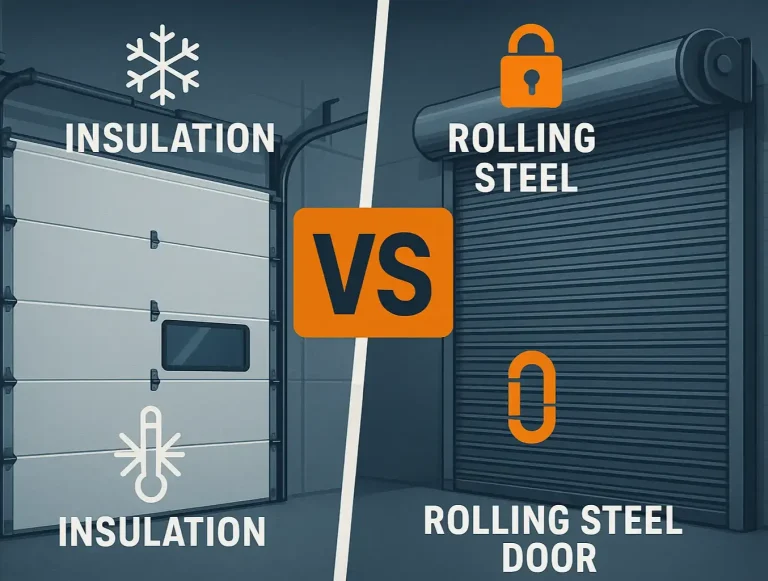
Sectional vs. Rolling Steel Commercial Doors: Which is Best
Choosing a commercial garage door can feel like a simple line item on a facility budget, but it’s one of the most critical decisions you’ll make for your business's security, efficiency, and profitability. The wrong…
Published Date: Jun 9, 2026
High-Cycle Commercial Doors for Distribution Centers and Warehouses
That sound you hear isn’t just a truck backing up to the dock. It’s the rhythm of your entire operation. Every time a loading dock door groans open and slowly closes, it’s a beat in that rhythm. But what if that beat…
Published Date: Jun 8, 2026